By: Fidel Gutiérrez"Abiseo, Cultural Forest of the Chachapoya" is the title of the documentary that has been available for free online since last week, showcasing an area where, amid unique flora and fauna, pre-Columbian architectural structures of great historical and aesthetic value rise, including those that make up Gran Pajaten.
The audiovisual production—which can be viewed at this link—was directed by Rosemarie Lerner and produced by World Monuments Fund (WMF) Peru, an organization that is likewise conducting an expedition that researches the pre-Inca structures in Rio Abiseo National Park and promotes site conservation.
Its director, Juan Pablo de la Puente Brunke, told Andina News Agency it is necessary to take into account that this area of the country combines the Chachapoyas' cultural expressions with exceptionally vast natural wealth.
The documentary begins as the WMF Peru expedition sets out in Pataz, in La Libertad region's Andean highlands. The team crosses the Andes mountain range before descending into San Martin region's Amazon rainforest, where Rio Abiseo National Park is located.
Within this vast natural area lies the upper Montecristo River valley, home to Gran Pajaten and other settlements once inhabited by the Chachapoyas.
"Completing the project has been quite a logistical challenge," De la Puente Brunke said, referring to the rugged terrain and harsh weather conditions in Rio Abiseo National Park.
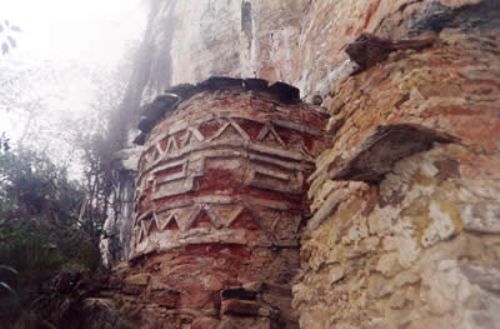
Amid rain and forests
The area experiences torrential rainfall for nine and a half months of the year.
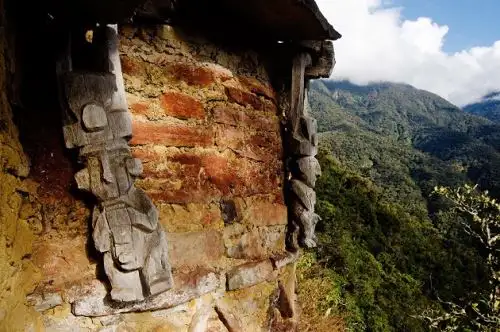
"What we see on screen is very useful in helping the general public understand what the work of preserving this cultural heritage entails, as well as the efforts carried out by archaeologists," De la Puente Brunke indicated.
"For the first time, the upper Montecristo River valley topography has been documented in the highest image resolution. That is what viewers will be able to see," he said.
The film has already been screened at museums, universities, and cultural centers in Lima and San Martin, as well as at forums in Spain, Italy, and the United States. It can now be viewed free of charge on YouTube via mobile phones and computers.
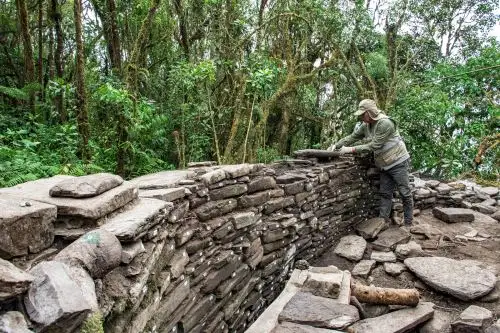
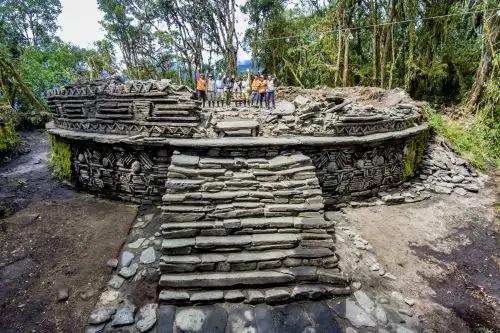
"This has been the first expedition in which conservation work was carried out, focused on a circular structure at Gran Pajaten that had collapsed," the WMF Peru representative said.
The spread of vegetation has affected the stability of the structures there, he mentioned.
When Gran Pajaten was abandoned by the Chachapoyas, for reasons that have yet to be determined, the forest continued to grow, affecting the constructions and causing some of them to become uneven.
This situation has required attention from researchers to prevent the structures from continuing to deteriorate.
As a result of this work, the organization established an intervention protocol that it has submitted to the Ministry of Culture so that it and other institutions may apply it.
"It is a first conservation experience" in areas such as this one, he said.
World Heritage Site
UNESCO considers Rio Abiseo National Park a Mixed World Heritage Site because it features structures and buildings created by ancient cultures, as well as exceptionally diverse flora and fauna, including more than 100 endemic species — meaning they exist only in that location.
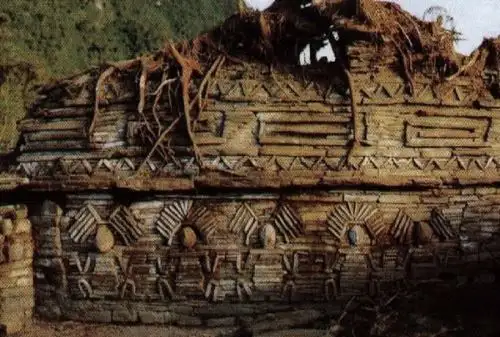
In Peru, the area shares this classification with the Historic Sanctuary of Machu Picchu, which also contains both cultural and natural heritage.
Unlike the latter site, Gran Pajaten and the complex known as Los Pinchudos are not open to tourism, De la Puente Brunke said.
"It is an extremely fragile area, not only because of the archaeological remains found there, which require preservation, but also because of its biodiversity," which includes endangered species such as the yellow-tailed woolly monkey.
The expert added that the architectural complex likewise requires further study and research.
Pending tasks include making further progress regarding Cerro Central, another settlement featuring buildings about which "very little" is currently known, he indicated.
More than 100 structures
The first research efforts date back to 1963. A later study, conducted in 1985, determined that Gran Pajaten consisted of 26 semicircular structures characteristic of Chachapoyas Culture.
The most recent research—carried out between 2023 and 2025—has determined that there are actually more than 100 structures of this kind at the site.
The use of optical technology, such as laser-based light detection known as LiDAR (Light Detection and Ranging), as well as drones and other equipment, contributed to consolidating this finding.
"There was clearly a design, territorial planning, as well as a dedication of resources and labor to build these more than 100 structures," De la Puente Brunke remarked.
Regarding Los Pinchudos, the WMF Peru representative said it is a funerary site. Like others of its kind belonging to Chachapoyas Culture, it is located near a cliff and steep precipices.
Similar structures can be found in other areas where this culture developed, in Amazonas region. These include the sarcophagi of Carajia and those of El Tigre Hill.
According to archaeologists' observations, several of these monuments may have had a religious connotation, serving as places of worship.
Other smaller structures may have served as dwellings for the Chachapoyas, with these buildings also showing particular attention to architectural detail.
What has yet to be determined precisely, however, is why construction was chosen in an extremely rugged area such as the one where Gran Pajaten is located, De la Puente Brunke said.
"It is an area where research needs to continue. We do not really know everything that exists there, but through our project we can provide visual, narrative, and technical information," he expressed.
(END) FGM/MVB
Publicado: 18/5/2026