08:42 | Chachapoyas (Amazonas region), Sep. 17.
The
Pishca, or Pichca, a pre-Hispanic object resembling a "die" discovered at the Ollape archaeological site, is the first of its kind found in northern Peru.
It dates to the period of Inca occupation and may have been used for ritual purposes to communicate with oracles.
Archaeologist Pablo Solis, who leads the research project at this site in the La Jalca Grande district, Chachapoyas province, Amazonas region, made the revelation.
In an interview with Andina News Agency, the archaeologist said the hypothesis regarding the ritual use of this Pishca or Pichca is based on ethnohistorical research conducted by anthropologist Margarita Gentile, a specialist in this subject who has published books on the object.
She found that its oldest function was related to communication with oracles.
"People had to ask questions of their Huacas or Apus, and there was a specialist who used this object by throwing it onto the ground. The answer from the huaca was interpreted based on how it landed and which side, bearing a symbol, was facing up," Solis stated.
He added that, in the early colonial period, the Pishca changed its use and became a recreational object associated with wakes or vigils for the deceased.
Later, the Pishca continued to be used, but no longer in a context of bidding farewell to the deceased.
Instead, it took on an exclusively recreational purpose in which only clothing or other personal belongings of participants were wagered, but not money or financial assets, Solis remarked.
"Taking this information and its estimated age into account, we believe that the Pishca discovered at the Ollape archaeological site may have been used to communicate with Huacas," he stated.
However, the researcher stressed that, since excavation work in the area is still ongoing, all the finds must be placed in context, as Inca pottery has also been discovered, in order to corroborate the hypothesis and arrive at a more reliable interpretation.
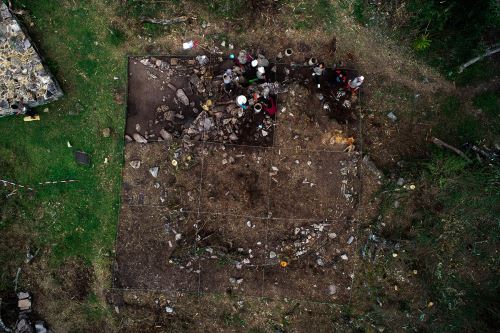
He said the discovery was made outside Circular Enclosure 166, which is part of Excavation Unit 9.
Work on the unit began in July this year as part of the third fieldwork season at the Ollape archaeological site.
The project was launched in 2024 at the initiative of the Kuelap Institute of Archaeology and Anthropology Research (INAAK) at the Toribio Rodriguez de Mendoza National University of Amazonas, with the support of the Spanish Agency for International Development Cooperation (AECI).
First Pishca found in northern Peru
The specialist noted that this Pishca is the first one found in an archaeologically excavated context in northern Peru.
Solis noted that only a few have been discovered nationwide to date.
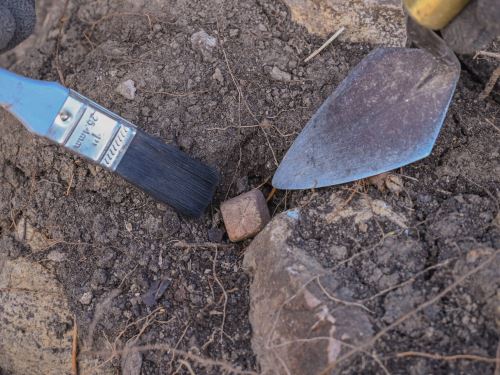
He explained that, so far, pishcas have only been found and documented at three other sites, in addition to Ollape.
They were found at Huaca Tres Palos, part of the Maranga Archaeological Complex, located within the Parque de las Leyendas in Lima's San Miguel district.
They were also found at the Inca temple of Pachacamac, which housed an oracle and is located in Lima, and at the Inca citadel of Machu Picchu, in Cusco.
Outside Peru, several Pishcas have been found in northwestern Argentina, where Inca presence extended during the greatest expansion of Tahuantinsuyo, or the Inca Empire.
Similarities and differences
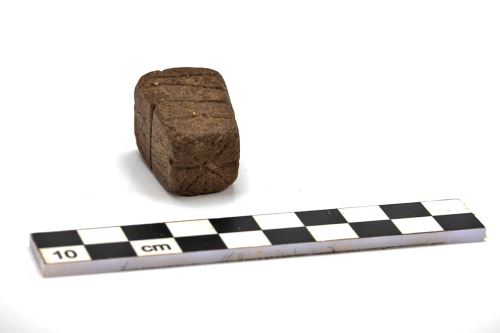
The specialist noted that the Pishca discovered at Ollape resembles those found at the aforementioned sites in its elongated, prismatic shape, with worked surfaces and horizontal incisions on its faces.
The base measures 2.2 centimeters, the top 1.4 centimeters, and the height 2.6 centimeters.
However, it differs in terms of the material from which it was made, as it was crafted from sandstone.
Those found at Huaca Tres Palos, Pachacamac, and Machu Picchu were made of wood and ceramic.
Estimated age
The archaeologist said that although radiocarbon dating remains to be carried out to determine the age of the Pishca discovered at Ollape, its association with the period of Inca occupation in Amazonas region can be established based on the ceramic artifacts found there as well.
This period corresponds to the Late Horizon, around AD 1400.
Research continues
The researcher emphasized that this discovery shows that Ollape still has much to reveal.
Three tenon heads and more than 200 structures were discovered there in August this year, while two underground ducts were found in October 2025.
He added that excavations at Ollape will continue through November this year.
Solis said he hopes funding will continue to be available to carry out further excavations, as much remains to be investigated at this archaeological site.
"This archaeological site continues to amaze us and is giving us a new interpretive perspective on the development of pre-Hispanic societies in Amazonas region," he concluded.
(END) LZD/MAO/MVB
Publicado: 17/9/2026