Excavations carried out at the former church of Pueblo de Nuestra Señora de Guadalupe (The Town of Our Lady of Guadalupe) in Anlape, Pacasmayo province, northern La Libertad region, have revealed that the temple continued to be used for burials after the earthquake that destroyed the settlement in 1619.
From temple to cemetery
This season's excavations focused on two areas of the church: the main entrance and the high altar.
In the former, 13 funerary contexts were identified, corresponding to adults and subadults who lived in Pueblo de Nuestra Señora de Guadalupe during the period between 1570 and 1619.
According to Ascencio, these burials were part of a practice characteristic of the early years of evangelization.
People were buried inside churches because cemeteries as they would later be established did not yet exist.
The temple's history is also linked to the process of reducing Indigenous populations promoted during Viceroy Francisco de Toledo's administration.
According to the researcher, the site received funding associated with Toledo.
There was particular interest in devotion to Virgen de Guadalupe (Our Lady of Guadalupe), to whom the town had been entrusted.
After the earthquake
The most striking discovery was made in the high altar area.
A total of 56 funerary contexts were recorded there, all corresponding to subadults, that is, children and young people.
The particularity is that these burials were found on top of the debris that covered the church during the earthquake on February 14, 1619.
The archaeological evidence therefore indicates that people continued using this space to bury their dead, even though the temple had already become unusable.
Carbon-14 analyses were crucial to establishing this sequence. The dates obtained for some of the remains are later than the earthquake.
The finding shows that the site's use for burials continued after the church was destroyed.
According to the archaeologist, this finding is particularly significant because it shows that the building's abandonment did not necessarily mean that the area was immediately abandoned.
The former church retained a function linked to the community even after being buried under debris.
Children among the ruins
The concentration of children's burials in the altar area opens up a little-known line of research as well.
Ascencio noted that there is little historical information about this practice because such events were not always recorded in documents from the period.
One of the burials also contained a beaded necklace. The object associated with the individual constitutes evidence suggesting occupation during the Late Colonial period.
The research thus makes it possible to reconstruct a longer history of the former church.
The building was constructed after 1570, served as a religious-funerary space, and was rendered unusable by the 1619 earthquake; despite this, it continued to receive burials.
Rather than simply being a set of ruins, Anlape appears to have remained a place connected to the local population over time.
The graves dating to after the disaster show that the site's memory survived the disappearance of the church.
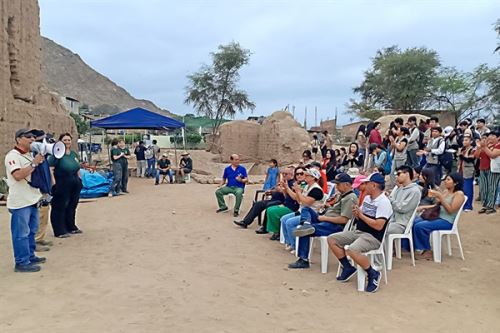
69 funerary contexts were found during the most recent excavation season.
Publicado: 17/9/2026