13:26 | San Salvador, oct. 30.
President Keiko Fujimori invited business leaders from El Salvador today to invest in Peru and leverage its strategic location to develop businesses and access other markets in the region, highlighting the opportunities the country offers as a logistics and commercial platform in South America.
“Peru’s geographical location in the heart of South America allows us to serve as a logistics hub—a point from which you, our friends from El Salvador, can arrive and subsequently expand your investments throughout the rest of South America,” she stated.
She made these remarks during a meeting with representatives from the Salvadoran business sector.
In her address, President Fujimori emphasized the robustness of Peru’s constitutional framework and the guarantees it provides to both domestic and foreign investors, particularly regarding monetary stability and the predictability of economic rules.
“Peru possesses a very solid constitutional framework. Beyond public safety, what business leaders seek most is legal certainty,” she maintained.
In this context, she recalled that the country endured a severe inflationary crisis between 1989 and 1990—an experience that led to strengthening the independence of the Central Reserve Bank of Peru (BCRP) as a key safeguard for preserving the stability of the national economy.
Furthermore, she highlighted the reappointment of economist Julio Velarde to lead the institution for another five years, as well as the composition of a board of directors that will ensure the continuity of monetary policy.
“For us, safeguarding the Central Reserve Bank and maintaining its autonomy and independence is fundamental,” she stressed.
Equal conditions for investors
Additionally, she noted that Peru’s Constitution establishes equal conditions for the participation of both domestic and foreign capital, which has helped attract investment and bolster confidence in the Peruvian market.
"In our Constitution, we accord the same treatment—and impose the same responsibilities and requirements—on both Peruvian and foreign investors. This openness has enabled us to attract a great number of investors," she stated.
The head of state also highlighted the results of the country’s fiscal discipline, noting that these indicators serve as a strength for addressing the economic challenges of the coming years.
"Currently, Peru has a fiscal deficit of 1.4% of its GDP and a public debt of 29% of its GDP. These are very solid figures," she remarked.
Regarding the risks posed by the arrival of the El Niño phenomenon, President Fujimori explained that the strength of the public accounts allows the government to implement extraordinary measures to protect families, boost infrastructure, and sustain economic activity.
"We know that a 'mega' El Niño is approaching, which could reduce Peru's growth by 1%. We are taking robust, counter-cyclical investment measures—precisely because we have the fiscal capacity to make such decisions," she noted.
In this context, the president acknowledged that, despite the economy's favorable performance, Peru has experienced periods of political instability in recent years; in response to this, she highlighted the reforms undertaken to strengthen the functioning of the country's institutions.
"Corrective measures have been taken to provide greater political stability to Peru," she affirmed.
Investment opportunities
Furthermore, the head of state emphasized the openness of the Peruvian market and the country’s participation in international economic integration mechanisms—such as the Pacific Alliance and the Asia-Pacific Economic Cooperation (APEC) forum—which help strengthen trade relations and expand business opportunities.
She underscored Peru’s productive transformation, which has solidified the country’s role in sectors such as mining and fishing, while also significantly expanding its presence in international markets through agricultural exports. In this regard, he mentioned the progress made in the production and commercialization of blueberries, grapes, asparagus, and avocados—sectors that, he noted, have contributed to the creation of millions of jobs.
"We have become the leading producer and exporter of blueberries, grapes, and asparagus. We rank second in avocados, and this has helped generate millions of jobs," he stated.
He explained that the country has various instruments in place to facilitate private sector participation in project development, through models that allow for the channeling of resources into infrastructure works and public services.
“We invite investors to invest, including through open competitive bidding processes. We have mechanisms such as public-private partnerships, government-to-government contracts, and the ‘works for taxes’ mechanism,” she noted.
Regarding the latter, she highlighted that it allows for linking business activity with the needs of the population by facilitating the financing and execution of public projects in the areas where investments are being made.
“Instead of paying your taxes, you can build a road in the area where you are investing. Furthermore, this brings investors closer to the communities,” she stated.
Commercial integration
Regarding economic relations between Peru and El Salvador, President Fujimori reported that negotiations for a free trade agreement (FTA) are progressing well, with 14 of the 19 chapters already finalized by the technical teams from both countries.
Nevertheless, she emphasized that this process should not prevent Salvadoran businesspeople from beginning to explore business opportunities and establishing new investments in Peru.
“We want to sign an FTA between El Salvador and Peru. We are well on our way in that process—14 out of 19 chapters are already settled. But I do not want you to wait for the free trade agreement to be in place; I invite you to invest now,” she stressed.
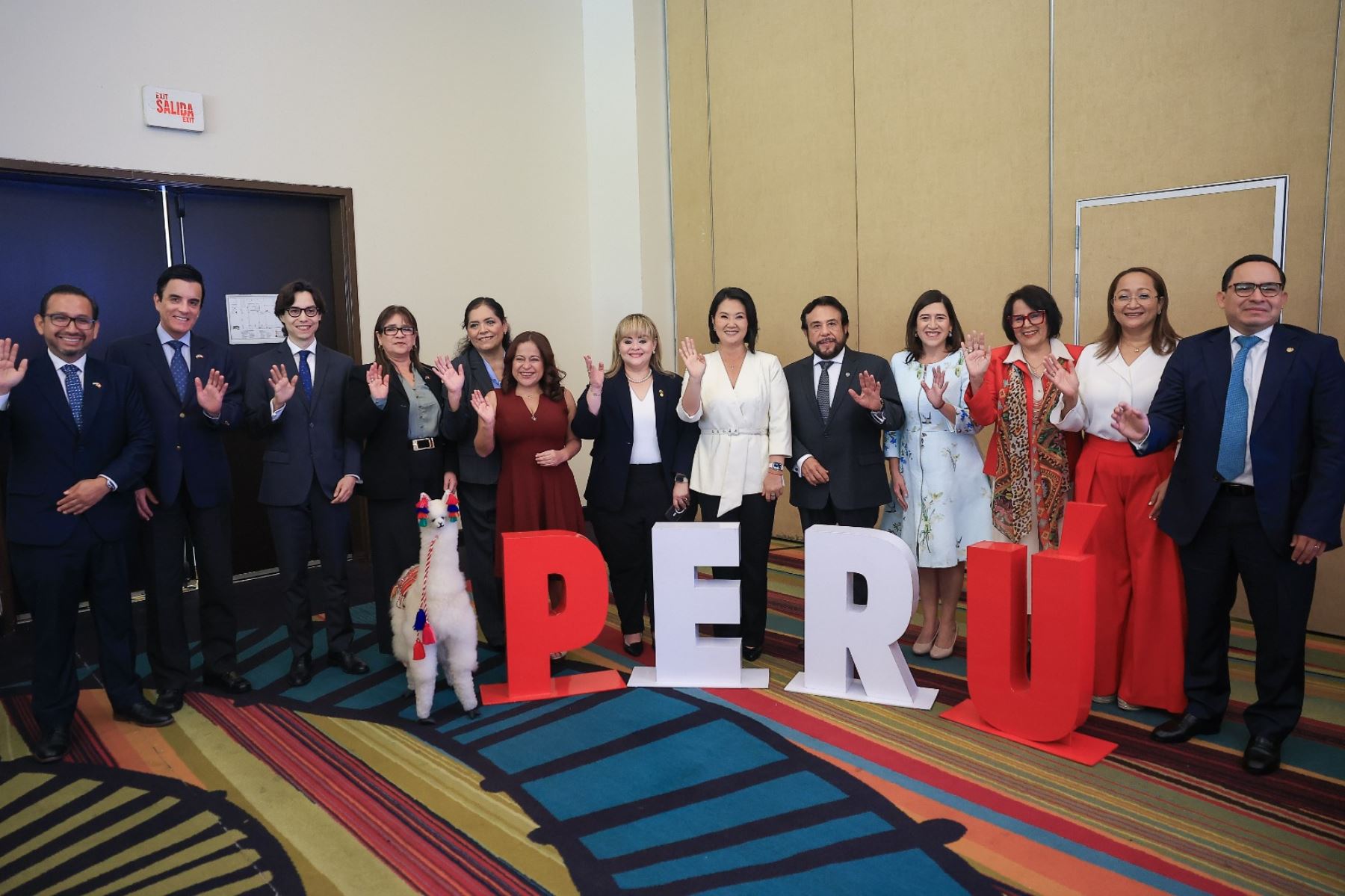
The meeting took place as part of her official visit to El Salvador and was attended by the country’s Vice President, Félix Ulloa; the President of the Chamber of Commerce and Industry of El Salvador, Leticia Escobar; and representatives from companies interested in investing in Peru, as well as firms already operating in the Peruvian market.
During the event, the Head of State was accompanied by the Minister of Foreign Affairs, Carlos Espá; the Minister of Health, Luis Dyer; and the Vice Minister of Pedagogical Management, Miriam Ponce.
More from Andina:
(END) NDP/ETA/RMCH / MDV
Publicado: 30/10/2026