This care must be extended "especially to the poor," the Supreme Pontiff said.
Therefore, he added, it must be a requirement of Catholics' missionary work to "listen to the social and cultural reality, defend human dignity," and accompany society's most vulnerable sectors.
Among them, the Supreme Pontiff mentioned "families, youth, migrants, Indigenous peoples, and people living in poverty."
"Commitment to justice, peace, and the common good are not optional tasks; they are demands of our ecclesial mission," Pope Leo XIV stated.
In his address, His Holiness emphasized the importance of the concept of synodality within the Catholic Church, stating that it "expresses the idea of walking together."
"I encourage you to increasingly discover the beauty of being synodal communities," he said.
The Pope explained that this idea is reflected in "a community-based and pastoral way of life that must be internalized so that it can be put into practice coherently."
To reach this point, the Holy Father recommended developing "a spirituality rooted in prayer, listening to the Word, participating in Holy Mass, Eucharistic adoration, fraternal dialogue, and community discernment."
Likewise, Pope Leo XIV urged dioceses and parishes to adopt synodality by establishing a pastoral council in each community, "whose members must also commit to receiving appropriate training."
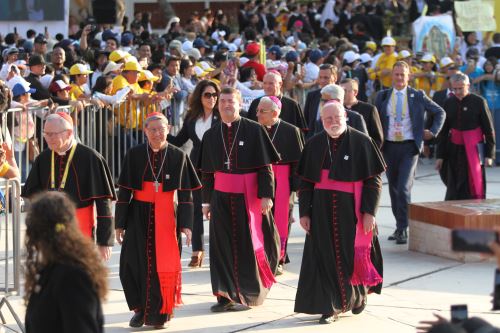
After delivering this address, the Holy Father bid farewell to the religious leaders with the Lord's Prayer.
As the Pope departed, he was greeted by everyone and received several gifts.
Next, the Holy Father headed to the Catholic University of Santo Toribio de Mogrovejo, where he met with young people from the host city.