00:37 | Sacsamarca (Ayacucho region), Jan. 18.
Perched at more than 4,000 meters above sea level in Sacsamarca district, Huanca Sancos province, Ayacucho region, the Pachapupum "volcano"—this unique natural monument—is a must-visit destination for both domestic and foreign tourists traveling to this part of the country.
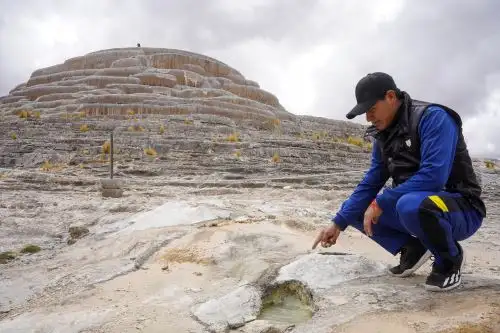
Pachapupum comes from Quechua and means "navel of the earth" (pacha: earth/world; pupum: navel). It is an inactive geyser located at 4,022 meters above sea level.
"Popularly referred to as a 'volcano' because of its conical shape, Pachapupum is, from a geological standpoint, an inactive geyser," said Romulo Ayala, of the travel agency Kuska Travel, in remarks to Andina News Agency.
"This is a geological marvel formed over thousands of years by the upwelling of mineral-rich thermal waters—mainly salt and sulfur—which, upon reaching the surface and cooling, deposited these minerals layer by layer, eventually creating a limestone cone that today rises to an approximate height of 30 meters," he detailed.
Ayala added that tourists wishing to visit Pachapupum should plan the trip for the second or third day of their stay so as to avoid being affected by the high altitude.
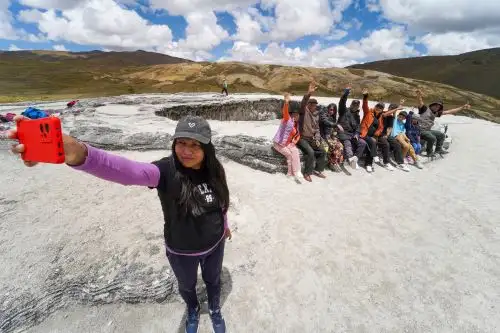
He reported that dozens of travelers make their way to its foothills not only to admire the surrounding limestone landscape, but also to enjoy the unique experience of immersing themselves in its thermo-medicinal waters, making Pachapupum one of the most visited attractions in Ayacucho region.
"The ideal season to visit Pachapupum runs from May through mid-December, as the rainy season begins thereafter," Ayala noted.
Upon reaching the summit of the "volcano," visitors can see a circular opening measuring approximately 10 meters in diameter.
By carefully peering inside, they can observe bubbling water and gas emissions at the bottom, giving it the appearance of an "active volcano."
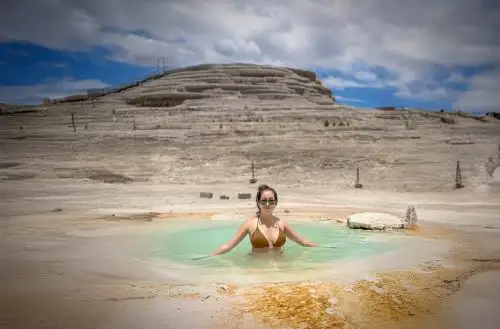
Around the "volcano," visitors bathe in natural pools of thermo-medicinal waters, which are highly valued by local residents and tourists alike for their purported medicinal properties, particularly for relieving muscle and bone pain.
Likewise, people apply the mud to their faces due to its beneficial properties for the skin.
How to get there
Reaching this natural wonder requires an adventurous spirit, as it lies far from traditional tourist routes.
Along the way, travelers encounter waterfalls, canyons, flower-filled plateaus, and wildlife such as condors, vizcachas, and Andean camelids.
From the city of Huamanga (Ayacucho region), the journey by car or minibus takes approximately five hours. Meanwhile, the trip lasts between eight and nine hours from the city of Ica.
The most common route is to travel to Huanca Sancos province, reach its capital (Sancos), and then continue on to the Sacsamarca district to visit this natural wonder.
Once in the area, climbing the "volcano" is easy, as the Sacsamarca community has installed a wooden staircase. The entrance fee is S/5.00 (about US$1.50).
Recommendations
Visitors are advised to bring swimwear and a warm jacket, as cold wind gusts typically begin after 3:00 p.m.
(END) GBL/MAO/MVB
Publicado: 18/1/2026