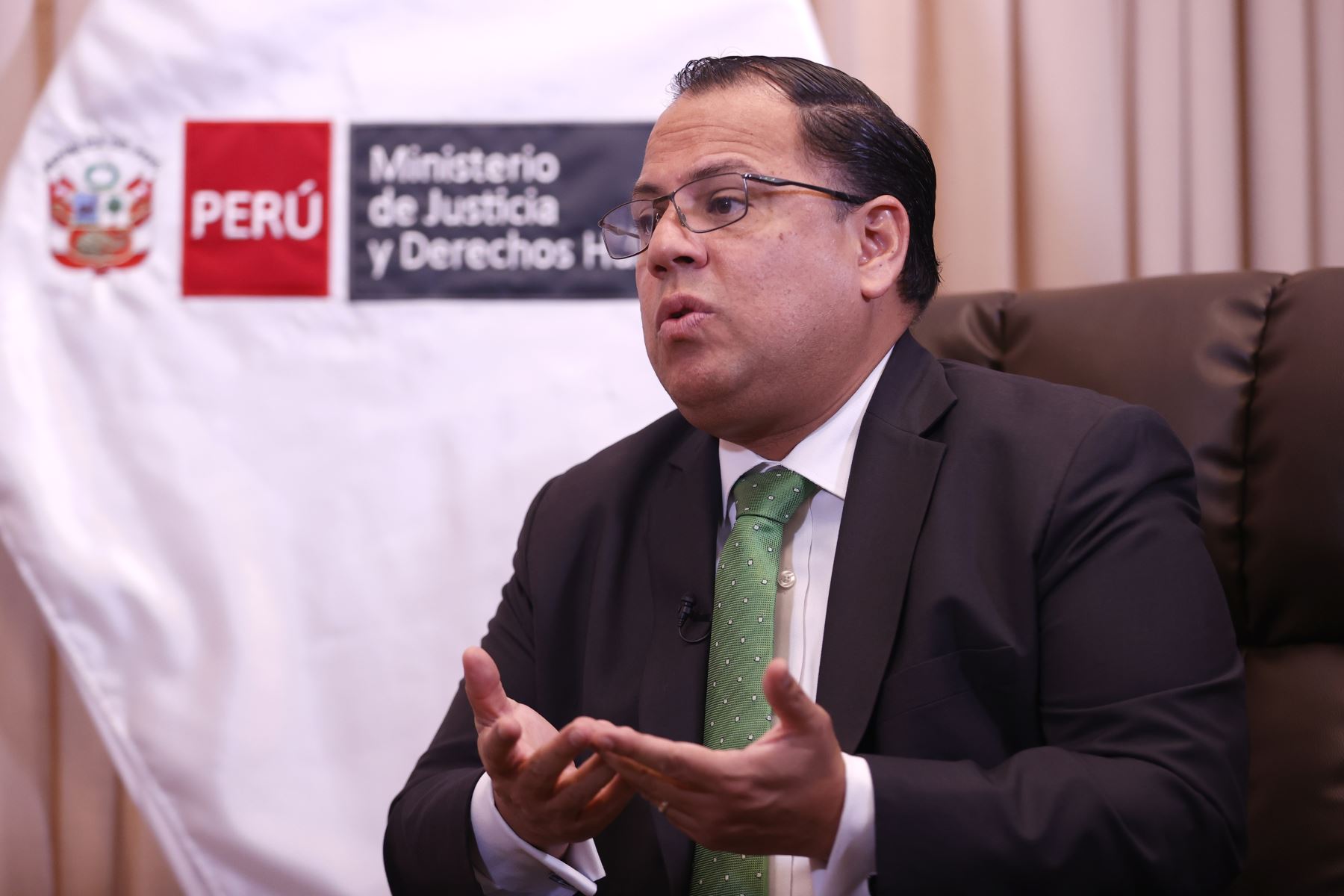
By Juan Carlos CruzadoThe Minister of Justice and Human Rights, Walter Martínez, affirmed that the government's nationwide strategy to combat crime planned from the prisons is yielding results and emphasized that they will leave a clear path for the next administration.
How has the ministry -under your charge- progressed in access to justice in 2025?
Regarding access to justice, the General Directorate of Public Defense is our most representative body, and through the Public Defender's Office, we assist people in vulnerable situations and those with limited resources, providing them with legal support so they can resolve their problems in court. This year, between January and October, we have provided more than 1.5 million services to this population.
How does this support translate into tangible results?
These services go beyond simply sponsoring legal proceedings or answering inquiries; they have an effectiveness that translates into savings of over 325 million soles for these individuals. This means that without the Public Defender's services, the population would have spent this amount. Similarly, in the case of child support, we have obtained over 46 million soles in favorable rulings.
And in the case of defending victims of crime?
In this case, the goal is not only to punish the perpetrator but also to secure civil reparations proportional to the harm suffered. In this area, we have obtained over 36 million soles for these individuals.
Another important tool is the Alegra Centers; what is the assessment of their effectiveness?
The Alegra Centers are free legal assistance centers, spaces managed by the Public Defender's Office and implemented with the support of the World Bank. We have top-notch offices in the country's main cities. So far this year, we have strengthened 15 Alegra Centers, 11 of which are Alegra Centers and four are Mega Alegra Centers.
What is the scope of this work supporting those most in need?
This year, we have served more than 221,000 people through Public Defender's Office campaigns and mega-campaigns nationwide, which are mobile services.
In other words, we don't wait for people to come to our offices; instead, public defenders go out to plazas, markets, and the most remote areas, bringing access to justice to these communities.
Regarding the fight against insecurity, how has the ministry under your charge worked this year?
One of the priority issues for this transitional government is citizen security, and this has generated a commitment from all state entities. The Ministry of Justice is no exception.
Within our areas of responsibility, we also collaborate in the fight against insecurity, and we do so through the prison system and the National Program of Juvenile Centers, where we work with adolescents. And here I must emphasize that we have made significant progress, not only in control and security, but also in the reorganization of the prison and juvenile justice systems.
This is exemplified by various operations carried out in these centers...
In the case of the National Penitentiary Institute (INPE), so far this year we have conducted 20% more searches in the 69 prisons we have nationwide, where we have made significant discoveries, including drugs, cell phones, electronic equipment, and a range of other prohibited substances and objects. So, as the President says, we have moved from defense to offense, and it is yielding results.
Regarding regulations at the prison level, what changes have been made?
We have achieved significant changes at the organizational level and in the disciplinary regulations of the prison system. Recently, the tightening of the special closed regime was approved, under which inmates in this regime will only have two hours of yard time, restricted visits, and the so-called "electric blackout."
Thus, they are not allowed to use any electronic equipment in their cells and only have light, nothing else. And we are replicating this nationwide. With this, what we want is to recover the principle of authority that has been lost.
These advances will provide a roadmap for the next government administration...
Definitely, [...] we are going to work tirelessly to lay a clear path for the next government. We don't want to leave them with any difficulties, but rather a smooth path so they can continue developing proposals and projects for the benefit of our population, especially in the area of public safety.
More on Andina:
(END)DOP / FHG / MDV
Publicado: 26/12/2025