By Percy BuendiaThe Military Police Court (FMP) will intensify its efforts to prevent crimes committed in the line of duty by personnel of the Armed Forces and the National Police of Peru (PNP) through legal guidance in training centers for both officers and non-commissioned officers, as well as in the units and departments of these institutions serving the nation.
This was stated by the new president of the Military Police Force (FMP), rear admiral (ret.) Dario Vasquez Rojas, who—in an interview with the official newspaper El Peruano—specified that the aforementioned strategy will be an important part of his administration of the entity during the period December 2025–December 2027.
Code
“The Military Police Criminal Code requires the Military Police Jurisdiction to carry out work to prevent crimes committed in the line of duty. In this case, what do we have to do? We must provide legal guidance, with an educational component. To whom? To personnel in training, officers, non-commissioned officers, and enlisted personnel in the units and departments,” he explained.
To that end, he explained, the Supreme Prosecutor's Office developed a dissemination plan, in coordination with the armed forces and the police, to provide this training, naturally aimed at strengthening discipline and ethics.
“Until now, the idea has always been prevention. But how do we prevent it? By disseminating information about what constitutes a crime committed in the line of duty. But who is responsible for understanding this? The Armed Forces, those in training, cadets, students, and the police,” he emphasized.
Vasquez stated that this initiative will involve visiting units and training schools of the Armed Forces and the National Police to disseminate information and explain what constitutes a crime committed in the line of duty and how they should conduct themselves in their routine duties.
“To that end, I obviously have to provide them with some tools on how to respect human rights and the procedures that must be followed in the use of force. In reality, the issue is not only jurisdictional but also technical,” he asserted.
The president of the FMP revealed that, in order to fulfill this objective, specific agreements must be established with the institutions to carry out these outreach activities within the armed forces and the National Police.
Career
“The idea behind prevention is to allow personnel to avoid committing infractions that, due to a lack of awareness, could, in this case, jeopardize their careers, because a sanction practically represents a break in their progress or trajectory, as it may even result in a negative score for promotion,” he warned.
Vasquez cautioned that the situation, even in more serious cases, could lead to legal proceedings and sanctions, which would represent a disgrace to the career of the military or police officer.
“It practically derails a young person’s career path simply because they are unaware of a procedure,” he noted.
“In reality, what we must understand is that when we in the military put on the uniform, it is an honor. But that honor also entails fulfilling our duty, which is to carry out our functions, whether as enlisted personnel or officers within military operations or in support of the police,” he emphasized.
The magistrate affirmed that the military or police officer must know their duties and their limits “because, logically, if I am given an order that is clearly illegal, even if it is a military order, I should not obey it. That is what I must understand.”
“It’s not that I disobey a superior’s order, but if I receive a clearly illicit or illegal order, and I understand those terms, then I can correct myself and perhaps do the same with the superior.
Therefore, this training from the ground up will allow us to safeguard personnel so that they act in accordance with their duties, the law, and, above all, with respect for human rights,” he emphasized.
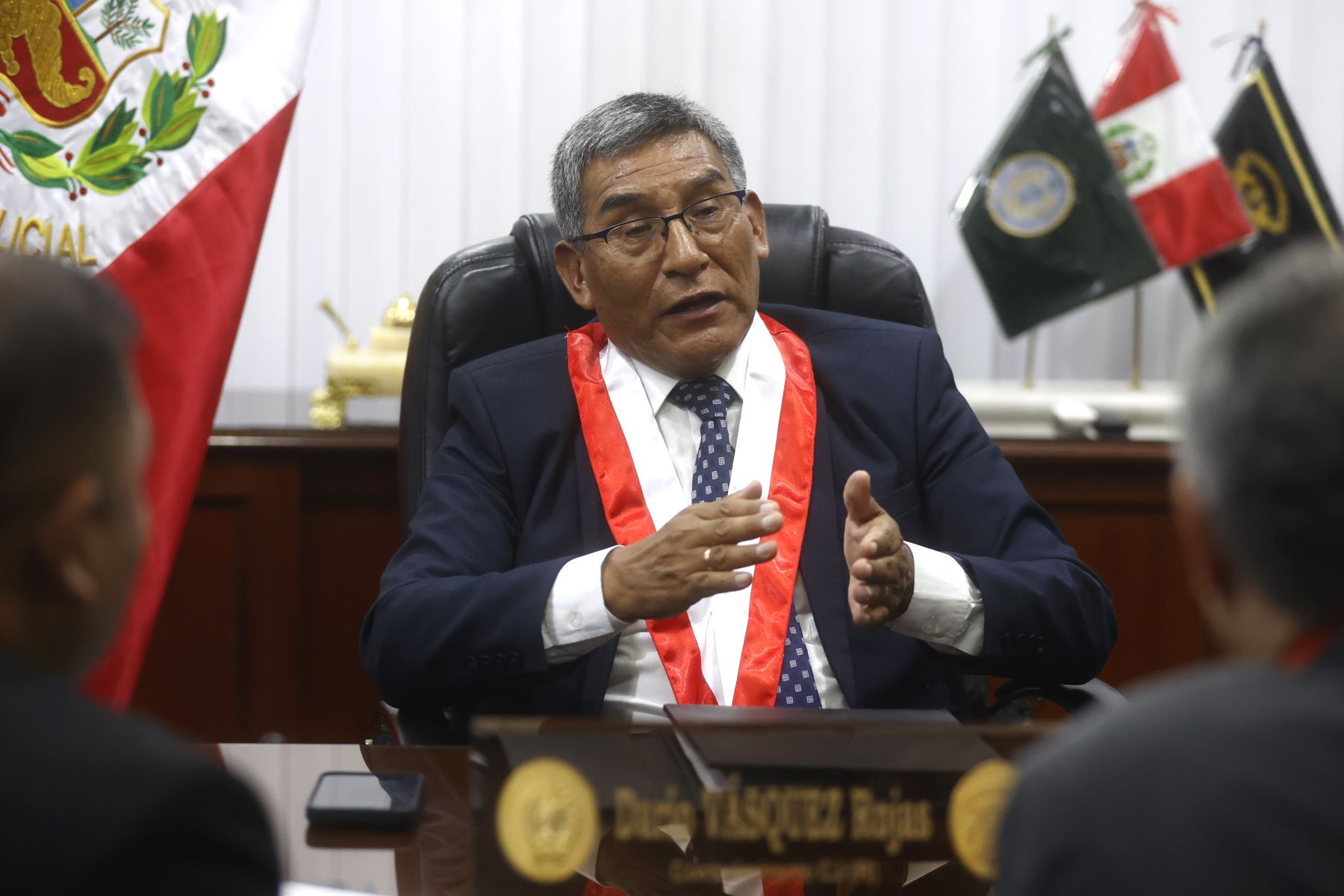
The president of the FMP stated that the implementation of early warning systems and exemplary sanctions, when warranted, will also be included.
“In this way, we will protect the operational capacity of the Armed Forces and the National Police of Peru,” he affirmed.
Autonomy
Vasquez maintained that guaranteeing the autonomy and independence of the Military Police Jurisdiction means ensuring its constitutional status, especially its jurisdiction over matters exclusively related to official misconduct.
“Sometimes, we have had jurisdictional disputes regarding cases that either fell under our purview or did not, or that fell under the jurisdiction of the civilian courts. Therefore, our task is to act, logically, in accordance with the constitutional mandate and the exclusive powers we possess,” he explained.
The president of the FMP stated that “what we must do now is, to some extent, integrate judicial and prosecutorial personnel to combat corruption, strengthening public trust in the military police justice system.”
History
The first Military Justice Code was officially enacted on December 20, 1898. As a result of this historic event, every December 20th is commemorated as the promulgation of this legal framework and celebrated as Military Police Jurisdiction Day.
To date, the Military Police Criminal Code, enacted by Legislative Decree No. 1094 of September 1, 2010, is the seventh in history and has been in effect for 15 years, during which time there have been significant changes in the application of specialized jurisdiction.
Official conduct offenses threaten legally protected interests related to the existence, organization, operation, or functions of the Armed Forces or the National Police.
More at Andina:
(END) DOP / FHG / MDV
Publicado: 26/12/2025