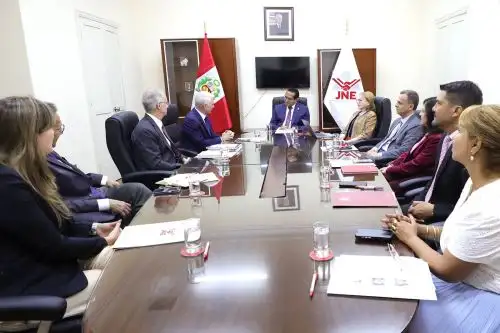
National Elections Board (JNE) Chairman Roberto Burneo held a working meeting with representatives of organizations specializing in political debates to advance the organization of the presidential debate, which will bring together the 36 candidates across two sessions scheduled on six dates between March and April.
Event planning began with a meeting held by the JNE head with executives from the National Democratic Institute, Francisco Herrera and Matt Dippel, along with Debates International representative Ruben Alvarez.
During the gathering, technical aspects and proposals to strengthen the debate format were discussed, taking into account the unprecedented number of political organizations participating in the process.
Dates and details
The debate, regarded as one of the main milestones of the electoral process, will be held across two major sessions spanning six dates.
According to JNE Education National Director Carlos Vilela, the first session will take place on March 23, 24, and 25, while the second is scheduled for March 30 and 31, and April 1.
The 36 candidates will be divided into groups of 12 per day, organized into thematic blocks that will allow for the presentation and comparison of proposals among contenders who will not appear together in every session.
Objective
The JNE stated that the debate serves as a forum for democratic dialogue, allowing citizens to learn about government plans and compare proposals before heading to the polls on April 12.
Vilela added that the JNE chairman will provide further details in the coming days, as meetings continue to define the debate's themes, moderators, and speaking times.
Additional initiatives
During the coordination meetings, additional initiatives were proposed to expand the information available to voters regarding the five elections to be held as part of this electoral process.
-Debates for young parliamentary candidates (ages 18 to 35).
-Presentation of proposals by candidates for the Andean Parliament.
-Regional parliamentary agendas, featuring the presentation of proposals by representatives in each region.
Thus, these measures aim to diversify information channels and strengthen civic participation.
(END) ETA/JCC/MVB
Publicado: 18/2/2026