09:30 | Trujillo (La Libertad region), Oct. 13.
More than 1,400 years ago, the sudden death of an infant belonging to the Moche elite led to an important funerary ritual at the foot of Huaca de la Luna, one of this pre-Hispanic society's principal religious temples, which settled in the valley of what is now the Moche district in Trujillo province, La Libertad region, northern Peru.
A few days ago, archaeologists from the Huacas de Moche Project, who were excavating the Uhle funerary platform, located next to the Courtyard of the Serpents, discovered the tomb of a child who may have belonged to the final period of this society.
Speaking to Andina News Agency, Huacas de Moche Project Director Carlos Rengifo highlighted the discovery's significance for Peruvian archaeology.
He noted that previous important tombs found on the Uhle funerary platform belonged to adults who had possibly attained a certain rank and status during their lifetimes, which were recognized upon their deaths.
However, the discovery of a child's tomb containing a significant number of offerings sheds light on the social status of the deceased.
"Peru's archaeological past is like an enormous puzzle, where each discovery, each adobe brick, each vessel, and each fragment helps us understand what happened, when it happened, and why these things are done. There are many things that we consider common sense; however, we see that, for these societies, our common sense is completely different," he added.
Tomb features
The expert specified that the child's tomb measures 1.20 meters long, 70 centimeters wide, and 1.20 meters deep. It features an enclosed structure typical of the Moche culture.
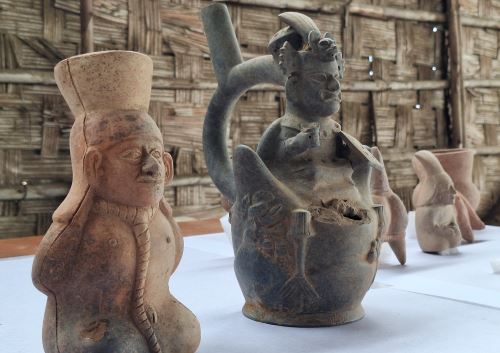
The child's funerary assemblage comprised 32 ceramic objects, including decorated plates and vessels depicting bird-shaped figures, prisoners, scenes of sacrifice, combat, and deities.
"We have also recently found that the area around the child's skull was covered with a kind of metal mask, which we believe could be copper and may have had decorations as well. There is another metal element toward the side of the foot bones," Rengifo indicated.
Items discovered
Enrique Zavaleta, the resident archaeologist on the project, reported that in his more than two decades of excavating at Huaca de la Luna, this was the first time he had encountered a tomb with this type of offering.
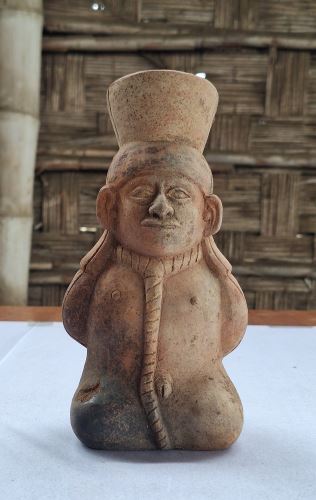
He indicated that the items found so far include a variety of vessel shapes, ranging from more commonly used ones, such as jars, vases, and bottles, to others that are much more elaborate.
Among the items that have attracted the most attention is a bottle, which is uncommon in Moche culture.
It depicts a coastal lagoon (a body of water separated from the sea by a strip of sand), featuring birds and fish, as well as two frogs associated with fertility and the presence of water.
"These animals in an area meant that there was a lot of moisture or that the rains were coming," Zavaleta explained.
Another item discovered is a bottle shaped like a prisoner, which, although commonly found in Moche burials, has the distinctive feature of being a mold used to manufacture the vessel.
"The true artists, when they make a mold of a national hero, later discard it, but here, for some reason, they kept it and even decorated it," he said.
Likewise, a bottle was found featuring many details that were made using other molds and applied to this ceramic piece.
One of them is the face of a feline that forms part of a headdress, with its claws protruding from either side of the figure's head and a feather decoration in the center.
The bottle's handle was made using a separate mold, as was the shield depicting a warrior.
"Whoever made this vessel used both molding and modeling techniques, which demonstrates great experience and knowledge in the manufacture of this type of piece," Zavaleta said.
"Although there is an element in the center that we have not found, the vessel is in good condition," he added.
The researcher mentioned that once each of these vessels has been removed, they will undergo a conservation process in order to preserve their color and original appearance.
Excavations to continue
Excavations in the infant's tomb will continue until each item in the funerary assemblage has been removed.
However, work on the Uhle platform will continue for another four weeks.
"As part of the comprehensive plan promoted by the Huacas de Moche Project and the National University of Trujillo, the focus is not only on funerary aspects but also on production, that is, the workshops where these types of objects were made in the urban area adjacent to Huaca de la Luna," Rengifo revealed.
Finally, the researcher said the aim is for each of these spaces to become part of the Huaca de la Luna tourist circuit and for the artifacts to be displayed at the Santiago Uceda Museum.
(END) LPZ/MAO/MVB
Publicado: 13/10/2026