The
sacred city of Pacatnamu could become one of Peru's most important archaeological projects because of its potential to reveal previously unknown aspects of the political, religious, and ceremonial organization of the pre-Hispanic societies of the northern coast.
This was stated by Canadian archaeologist Edward Swenson, co-director of the research underway at the monumental complex.
In remarks to the Andina News Agency, the researcher said excavations that began just two weeks ago have already yielded "very fascinating" results.
He noted that the findings strengthen expectations that the site could prompt a reassessment of hypotheses about the evolution of the cultures that inhabited the Jequetepeque Valley in Peru's northern La Libertad region, from the earliest periods through the Chimu era.
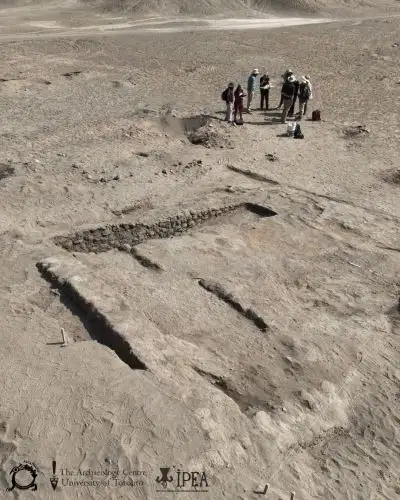
Swenson—a professor at the University of Toronto—noted that he has spent nearly three decades researching the Jequetepeque Valley.
During that time, the expert has conducted archaeological surveys that documented more than 1,000 sites, including domestic settlements, ceremonial centers, and monumental complexes.
"We want to better understand Pacatnamu's overall history and assess hypotheses proposed by earlier researchers, as the last systematic excavations were conducted in the 1980s," he explained.
Northern Peru's great oracle?
One of the project's main objectives is to determine whether Pacatnamu's principal huaca served as a major oracle, similar to the one that existed at Pachacamac in later periods.
The archaeologist said the team is also seeking to determine whether the site's more than 60 pyramids and ceremonial mounds formed a complex pilgrimage system, where different communities or ayllus came to worship and consult a principal deity.
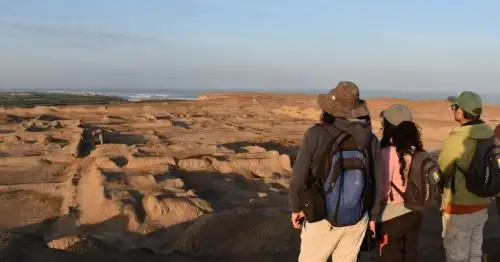
He explained that the site features a unique architectural layout, with at least 16 ceremonial complexes consisting of two pyramids surrounding a plaza.
One of the platforms faces the hill, while the other faces the sea, an arrangement that, according to preliminary interpretations, may reflect Andean concepts of complementarity between opposing forces.
"We want to determine whether each of these complexes belonged to different ayllus that were later integrated into a larger organization, a kind of macro-ayllu," he indicated.
Monuments hidden beneath other pyramids
One of the most important discoveries made during the first weeks of excavation has been the unearthing of Moche temples hidden within pyramids built later by the Lambayeque culture.
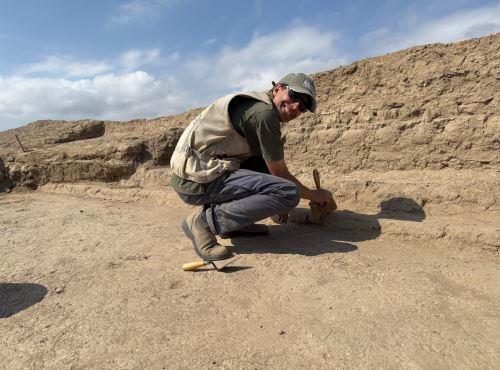
Swenson explained that the archaeologists found older monuments in a remarkable state of preservation beneath later structures, evidence that confirms a complex architectural superposition over the centuries.
"We excavated two pyramids in the northern sector and, inside them, found very well-built Moche temples, with construction quality that was even superior to that of the later Lambayeque-period structures," he pointed out.
The team also began investigations in an area north of the complex, where it identified structures dating to the Cupisnique period, including a U-shaped building characteristic of that cultural tradition that had never before been excavated.
Understanding the transition involving Moche, Lambayeque, and Chimu
According to Swenson, Pacatnamu offers an exceptional opportunity to understand the evolution of Peru's northern coastal societies across the Moche, Lambayeque, and Chimu cultures.
Unlike other major archaeological centers known for the tombs of their rulers, such as Batan Grande and Tucume, Pacatnamu may have served a different role, centered on religion and pilgrimage.
The researcher believes the site represents a different political and ceremonial model, where multiple communities shared a sacred space without necessarily having a single centralized power.
"It is a very unique city. We believe it was an important pilgrimage center that brought together communities from different parts of the northern coast through a major sanctuary or oracle," he stated.
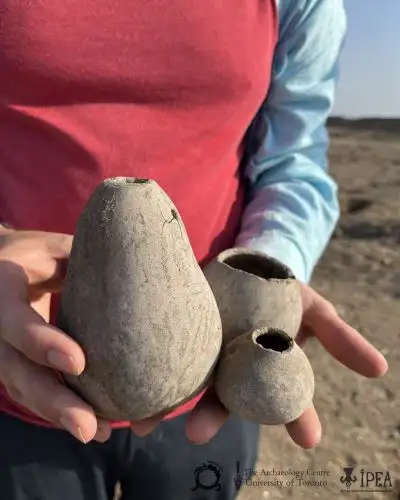
Swenson even compared its significance to that of other major ceremonial centers of the ancient world, such as Pachacamac on Peru's central coast, Cahuachi of the Nasca culture, and even Delphi in ancient Greece because of their religious role and their function as places of ceremonial consultation.
A long-term project
The Canadian archaeologist noted that the research is part of a long-term project being carried out together with Peruvian archaeologist Carito Tavera and researcher Henry Tantalean, including the participation of Peruvian and international specialists.
Among the next objectives is the excavation of residential areas where pilgrims may have stayed, with the aim of reconstructing aspects of the daily lives of those who came to the ceremonial center.
The team also hopes the new discoveries will help reconstruct the rituals practiced at Pacatnamu through the study of its monumental architecture.
Call to protect the site
Finally, Swenson warned that, despite its enormous archaeological significance, Pacatnamu does not receive the level of protection it deserves and remains vulnerable to looting.
In that regard, he called on the Peruvian Government to strengthen conservation efforts and foster permanent research initiatives that will make it possible to secure international funding.
He said the complex has enormous potential to become a major tourist and educational destination on the northern coast, particularly if a site museum is established to promote its extraordinary cultural heritage.
"Pacatnamu is one of the most important archaeological sites throughout the Andes and deserves far greater attention. With more research and conservation, it can become a leading cultural tourism destination and a key place for understanding the history of pre-Hispanic Peru," he concluded.
(END) MAO/MVB
Publicado: 21/7/2026