In just one week of excavations at the Pacatnamu archaeological complex in the Jequetepeque Valley, the Pacatnamu Archaeological Project documented food remains brought from different ecological zones, a sacred fruit used in blood rituals, pottery fragments of various styles, evidence of ritual temple burials, and layers of reoccupation by the Moche and Lambayeque cultures.
This was revealed by archaeologist Carito Tavera, director of the Pacatnamu Archaeological Project, in remarks to the Andina News Agency.
She highlighted that these findings help reconstruct the ritual life of the pilgrims who arrived at the sacred city of Pacatnamu over centuries.
The research is being conducted by a Peruvian-Canadian team co-led by Professor Edward Swenson of the University of Toronto and archaeologist Carito Tavera Medina of the Peruvian Institute of Archaeological Studies (IPEA).
In addition to food remains and pottery fragments featuring styles never before documented in the Jequetepeque Valley, the team has identified a fruit with strong ritual significance and evidence of ceremonial closures carried out before new structures were built over earlier ones.
A city reoccupied by successive generations
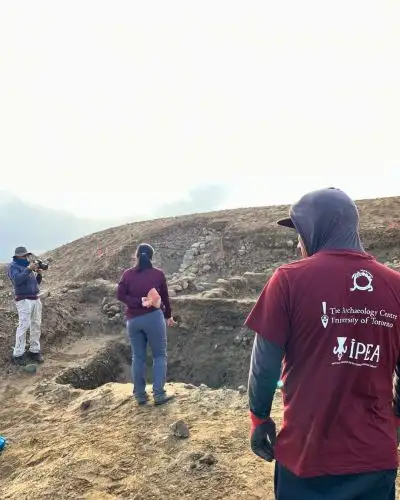
Tavera said the excavations are currently focused on the Huaca 34 sector, where archaeologists have found evidence of successive reoccupations of the site over time.
Some structures contain both Moche constructions and later remodeling attributed to the Lambayeque culture of the Late Intermediate Period.
According to the IPEA researcher, this pattern indicates that the buildings at Pacatnamu were not permanently abandoned, but were instead reused and transformed by different human groups that maintained a symbolic and ceremonial connection to the site for centuries.
"It also speaks to the idea of huacas, ceremonial centers and buildings as living entities that require care and renewal, as well as respond to the cycles of life and renewal within society," the archaeological project's co-director indicated.
Remains of a pilgrims' feast
One of the most revealing discoveries is an area dedicated to the preparation and consumption of food, evidence that—according to the archaeologist—helps explain how the sacred city functioned beyond its temples and ceremonial plazas.
She explained that the excavation unit yielded the remains of fruits such as cherimoya and lucuma, which are native to the upper reaches of the valley and not found in the lower valley, along with marine mollusks, fish, and the bones of camelids—llamas or alpacas—consumed as food.
According to Tavera Medina, the simultaneous presence of products from such diverse ecosystems confirms the extensive movement of people and resources converging at Pacatnamu during pilgrimages.
The sacred fruit that prevented blood clotting
Among the most significant discoveries of this first excavation season is a whole ulluchu fruit, a plant prominently featured in Moche iconography and associated with the figure known as the "Priestess of the Cup."
According to previous studies cited by the researcher, the plant is believed to have been used in rituals to prevent the blood used in religious ceremonies depicted in Moche pottery from clotting.
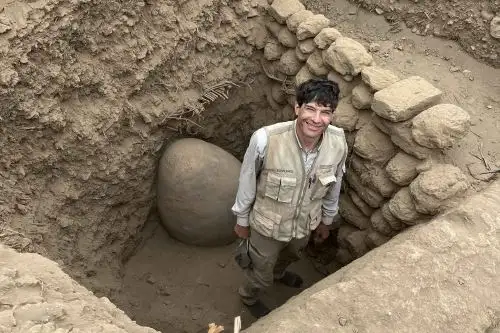
Although no offerings or funerary contexts have been found during this first excavation season, archaeologists did identify ritual architectural closure practices in which ancient temples were carefully covered before new structures were built over them, a process that shows huacas were regarded as living spaces requiring continual renewal.
Pottery never before documented in the valley
The team also documented pottery featuring decorative styles and forms that, according to Tavera Medina, Edward Swenson—who has conducted research in the Jequetepeque Valley for years—had never previously recorded in the area.
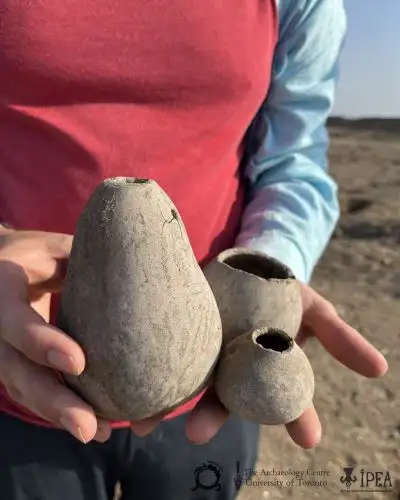
According to the project's co-director, this discovery raises new questions about how cultural identities were shaped around a ceremonial center on the scale of Pacatnamu, comparable in some respects to Chan Chan and, because of its role as an oracle and pilgrimage center, to Pachacamac.
"This project is focused on understanding how the city of Pacatnamu was built, recognizing that it was a site of mass pilgrimage in the Andean region. If we were to draw a comparison, Pacatnamu's sister site would be Pachacamac," the project's co-director, Carito Tavera Medina, said.
Digital archaeology to document the site's deterioration
Alongside the excavations, the project includes a digital archaeology component led by Professor Giles Spence Morrow of McMaster University, Canada. He compares historical digital photographic records with the site's current condition.
The aim is to accurately identify the areas most affected by looting and document the site's deterioration to support future conservation strategies.
Tavera Medina emphasized that gaining a scientific understanding of the site—how it was built and what evidence it preserves—is the most effective tool for promoting its protection and raising awareness of its historical value among the population and authorities.
An exploratory season, with more discoveries to come
The project's co-director explained that this first field season is exploratory in nature.
She added that the project is expected to span at least four seasons, during which the excavations will be expanded and the study of the evidence already documented will be further developed.
"Pacatnamu is an immense site. One could devote an entire lifetime to researching it and still have many questions left to answer," the specialist concluded.
(END) MAO/MVB
Published: 7/20/2026