13:45 | Viru (La Libertad region), Apr. 28.
4,500 years ago, the societies that inhabited the extensive Viru Valley, in what is now Peru's northern La Libertad region, regarded fire as a sacred element that enabled a connection between the earthly world and the spiritual or divine realm. Therefore, they built temples and altars to carry out important ceremonies devoted to this element.
Evidence supporting this hypothesis was recently uncovered by the multidisciplinary team of the Viru Valley Archaeological Project (PAVI), led by researcher Feren Castillo Lujan.
The discovery consists of two temples dedicated to fire worship, which would date to the Late Archaic period.
They were found at the archaeological sites known as Cerrito 2 and Cerrito 3, previously recorded by Gordon Willey (1953) and by the CHAVIMOCHIC project, although no excavations had been conducted there.
Cerrito 2
In remarks to Andina News Agency, Castillo explained that Huaca El Cerrito 2 was partially studied by the PAVI team in 2025.
At that time, the appearance of a curved corner drew researchers' attention.
During this fourth field season, they decided to open a 10-by-10-meter excavation unit extending from the building's main enclosure, as part of a thesis project by David Rios.
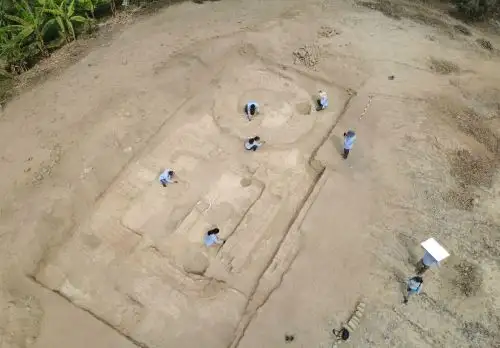
There, archaeologists uncovered a platform with curved corners, whose plastered surfaces are painted in ochre yellow.
On top of it sits an altar, at the center of which two ceremonial hearths were found, which would confirm the structure's role as a temple dedicated to sacred fire.
The National University of Trujillo (UNT) professor noted that the fire-worship altar measures approximately 9 meters by 9 meters.
Cerrito 3
At the same time, the team worked on a second excavation front at Huaca El Cerrito 3.
A 15.5-by-8-meter unit was opened as part of research conducted by Sonaly Chuyo, Eddie Carranza, Bruno Rojas, and Fernanda Rodriguez, a second group of interns from the UNT School of Archaeology.
Two enclosures were identified there: one with a quadrangular layout and rounded corners, and another with a circular plan.
Both spaces are connected by a network of corridors that allowed movement between them.
The walls were built with trapezoidal adobe bricks measuring 40 centimeters in length and 15 centimeters in height.
Some surfaces are plastered; although no mural painting has been documented, there are traces indicating they were once coated in ochre pigment.
In a third enclosure, evidence of a large ceremonial hearth was found, which would confirm the presence of another temple dedicated to sacred fire. Yet the team will need to confirm this hypothesis in a future excavation season.
Feren Castillo added that radiocarbon testing will be required to determine whether both sites were built during the same period or which one predates the other.
Social complexity
"These new findings from the excavations at Cerrito 2 and 3 are shedding light on the role of the Viru Valley in the reemergence of social complexity through the construction of these temples during the Late Archaic period, that is, between 2500 and 2000 B.C.," said the researcher, who is affiliated with the University of Rennes in France.
"These are highly significant discoveries that will help us understand how early societies developed increasingly complex spaces that appear to have been built for worship of fire. We will gradually interpret them alongside other findings, as we have already done at Huaca Tomabal," he added.
The PAVI director highlighted the support and generosity of local landowners whose agricultural properties contain these archaeological sites.
They have not only allowed excavations to proceed without difficulty but have contributed to improving living conditions for the entire research team.
He also noted that the excavation is funded by the Cine Chimu Cultural Center and the CReAAH at the University of Rennes (France), with additional support from 20 seventh- and ninth-term students from the UNT School of Archaeology.
(END) LPZ/MAO/MVB
Published: 4/28/2026