17:00 | Chucuito (Puno region), May. 6.
The choquelas, ancestral vicuña hunters, revived the traditional ritual dance on San Bartolome Hill in Chucuito-Juli province, Puno region, reenacting the capture of this sacred animal through an Aymara-origin practice filled with music, chants, and offerings to Pachamama.
From dawn, musicians, dancers, and residents gathered in front of Santo Domingo Church to ask permission from Virgen del Rosario (Virgin of the Rosary), Chucuito's patron saint, before heading up the hill.
The sound of bass drums, flutes, and sikuris (panpipe musicians) guided the procession toward the main stage, where Anthropology students from Altiplano University also joined the ceremony.
At the summit, the reenactment of the ritual hunt began.
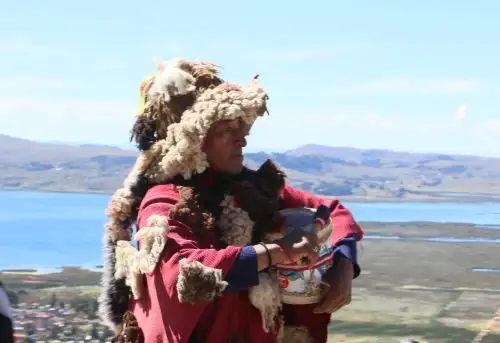
Figures such as the jila jinchu (chief sponsor), the choquelas (hunters), the women carrying llipis (decorated staffs), and the yatiri (spiritual guide) brought this tradition to life.
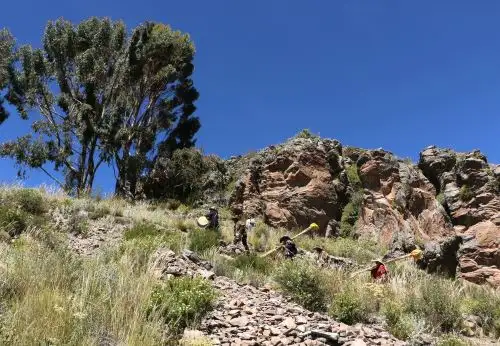
The women formed a human enclosure with sticks and colorful ribbons, simulating the ancient collective method used to capture vicuñas, while the hunters followed the trail of the wari t'ijuri, the young man portraying the animal.
After a symbolic escape, the vicuña was chased along the hill's slopes to the rhythm of the jayma, a ceremonial Aymara chant consisting of 43 verses dedicated to the hunt and to Mamita Rosario.
The female singers chanted phrases such as, "Hunt the vicuña, but carefully, our vicuñas are not domesticated," and "Be careful not to make the young (vicuña) follow, wait a little," recalling the respect for nature that has always guided this practice.
After an hour of music and dances, the choquelas sent up smoke signals to announce the symbolic capture.
The vicuña was taken before the jila jinchu, who performed the challa ritual and offered tributes to Pachamama (Mother Earth), a ceremony of gratitude for fertility and abundance.
The event concluded with a communal gathering among attendees, who shared and enjoyed what had been collected during the day.
This cultural expression, held every May 4, blends Andean and religious elements, such as the Feast of the Cross in May and offerings to the Earth.
It represents not only a living legacy of Indigenous peoples, but also a message of harmony with the environment and the transmission of knowledge across generations.
The participation of youth and students in the ritual reflects the interest in keeping this tradition alive, as it goes far beyond a simple dance.
It is an act of identity, where music, singing, and respect for the vicuña — a sacred animal in Andean cultures — come together to recall the importance of community and balance with nature.
San Bartolome Hill, the setting for this celebration, thus becomes a place for reconnecting with ancestral roots.
There, amid quenas and jaymas, Chucuito residents reaffirm their commitment to preserving a practice that has endured for centuries and continues to symbolize unity and spirituality.
The dance of the choquelas is not merely a historical reenactment, but a lesson in life.
Through its steps, chants, and rituals, it teaches new generations the value of cooperation, respect for animals, and connection with the sacred.
For the Aymara people, the vicuña is not just an animal, but a being that embodies the Andes' resilience and purity.
Its ritual hunt, though symbolic, is an act of gratitude toward the Earth and its bounty. Thus, year after year, Chucuito celebrates to keep alive a tradition that is, above all, an act of both faith and community.
The combination of music, dance, and ritual in this celebration reflects Puno's cultural richness. Every detail, from the traditional attire to the offerings to Pachamama, speaks of a history that refuses to disappear.
(END) AAM/MAO/MVB
Published: 5/6/2026