17:15 | Cusco (Cusco region), Jun. 24.
The celebration of Inti Raymi, the magnificent Festival of the Sun—the largest event of Cusco's jubilee month and one of the most important festivities on Peru's tourism calendar—invites us to explore how this ceremony forms part of Cusco's identity and inspires pride among its people.
It also allows us to appreciate the elements that represent the Inca and Andean worldview, which constitute the essence of a cultural legacy that has remained alive through time.
To begin with, it is important to highlight the origins of Inti Raymi, which date back to the 15th century, during the reign of the Inca ruler Pachacutec, who established this festival in the city of Cusco—capital of the Tahuantinsuyo.
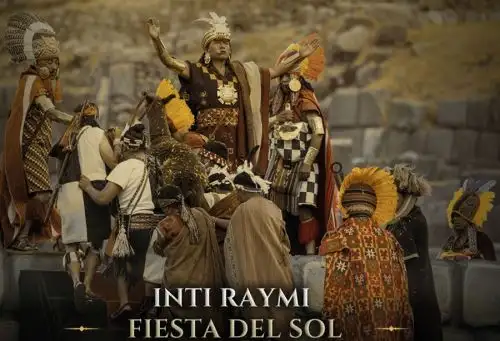
Inti Raymi was a religious and cultural tradition celebrated during each winter solstice, between the last week of June and the first week of July, marking the beginning of the agricultural year—a key activity for the economy and development of the expanding Inca Empire.
The Incas referred to the Sun God as Apu P'unchao or Apu Inti, in whose honor this magnificent tribute was dedicated to secure favorable harvests and ensure food supplies for Tahuantinsuyo's population.
At that time, the festival lasted 15 days, during which dances were performed and animal sacrifices were offered to the Inca civilization's supreme deity.
On the ceremony's opening day, the Inca used to emerge from the palace and head to Auqaypata Square, or Warrior Square (today Cusco's Main Square).
He was accompanied by an entourage of more than 300 Inca elite members known as Orejones (Big Ears) because they wore large gold earrings.
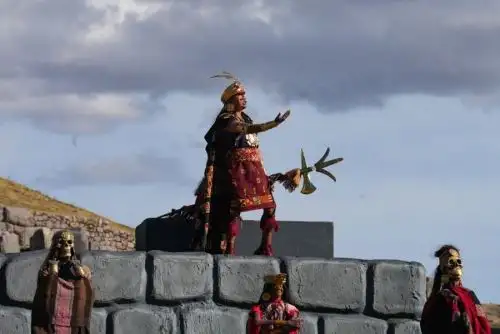
For Inti Raymi, around 50,000 people from across the empire's domains used to travel to Cusco to take part in this solemn celebration.
In 1572, Spain's Viceroy Francisco Alvarez de Toledo (1515–1584) banned this and all other Inca celebrations, considering them pagan ceremonies contrary to the Catholic faith.
However, the festival continued to be observed clandestinely in certain places, allowing this cultural legacy to endure through time.
Contemporary celebration
The proposal to celebrate the Festival of the Sun emerged in 1943, when a group of intellectuals from the Americas Institute of Art, led by historian Humberto Vidal Unda, conceived the idea of establishing a holiday for Cusco.
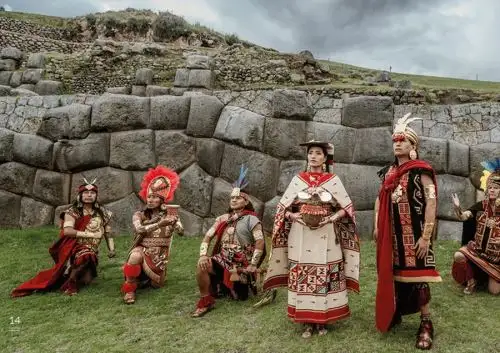
At the time, Dia del Indio (Indian Day), established by the Government of Augusto B. Leguía, was celebrated on June 24, just a few days after the start of the winter solstice. Indian Day was later renamed Farmers' Day, a designation that remains in effect to this day.
Following intensive efforts before government authorities, it was decided on January 8, 1944, to celebrate Cusco Day every June 24 and to revive for the world one of the greatest festivals of the Inca Empire: Inti Raymi.
On June 24, 1944, the contemporary version of Inti Raymi was reenacted for the first time at the fortress and current Sacsayhuaman Archaeological Park, with then-President Manuel Prado Ugarteche serving as guest of honor.
Quechua scholar Faustino Espinoza Navarro, who portrayed Pachacutec in this first reenactment of the Festival of the Sun—a ruler regarded as the most illustrious Inca in the history of the empire and the founder of the grand celebration—was responsible for writing the original script for the Inti Raymi reenactment.
At the time, a Central Executive Committee for Cusco Day was established to organize the program of celebrations, which included a grand gala performance, official luncheons, sporting events, an agricultural and industrial fair, as well as a visual arts exhibition.
Today, the Inti Raymi organization is overseen by Cusco's Provincial Municipality through the Municipal Company for Celebrations and Tourism Promotion of Cusco (Emufec).
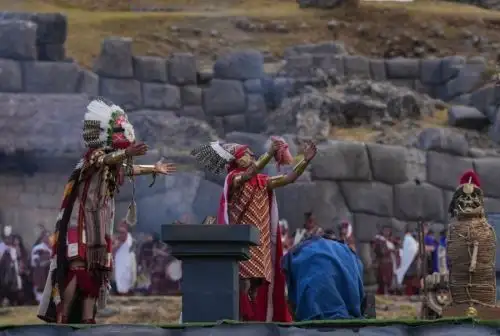
The organization responsible for staging this magnificent Inca ceremony has a collection of around 300 costumes.
Around 750 to 800 actors take part in the Inti Raymi reenactment.
The imposing Inti Raymi ceremony lasts approximately seven hours and unfolds across three venues: Qoricancha Temple's esplanade, Cusco's Main Square, and the Sacsayhuaman Archaeological Park.
The first reenactment takes place on the green esplanade of the Qoricancha Temple, whose name means "Golden Enclosure" in Quechua, as its inner walls were once covered with gold sheets. The temple was built by order of Inca ruler Pachacutec to worship the Sun God.
Following the Spanish conquest, the Santo Domingo Church and Convent were built on the Qoricancha Temple's foundations.
The second venue of the Festival is Cusco's Main Square, which during the Inca Empire was known as Auqaypata, or Warrior Square, where the ceremony was once held in its entirety around the great ushno (ceremonial platform).
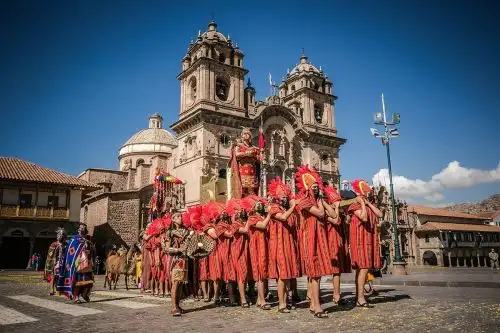
The central ceremony takes place at the Sacsayhuaman Archaeological Park, whose Quechua name can be translated as "Satisfy Yourself, Falcon."
It is a fortress built entirely of stone at an altitude of 3,555 meters above sea level, about one kilometer from Cusco's Qolqanpata neighborhood.
The events held at this imposing venue include the ceremonial gathering and the reports from the four suyos (regions) of the Inca Empire: Antisuyo, Chinchaysuyo, Contisuyo, and Collasuyo.
Cultural heritage
After more than three decades of celebration and in recognition of its growing international significance as Peru's most representative cultural festivity, Inti Raymi was declared Cultural Heritage of the Nation and the Official Act and Principal Ritual Ceremony of National Identity on March 3, 2001, under Law No. 27431.
Identity and Cusco pride
Over the course of these eight decades of celebration, Inti Raymi has become a symbol of identity that fills the people of Cusco with pride because of the rich array of cultural elements that converge at this festival and in the other celebrations held during Cusco's jubilee month.
This cultural expression not only honors an ancestral legacy, but also educates local residents, as well as domestic and international visitors, about the Inca worldview, helping to keep its spirituality and knowledge alive through time.
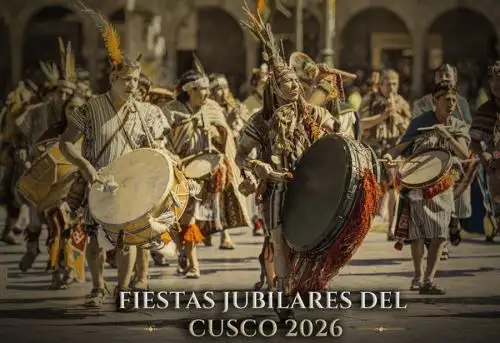
Inca worldview and symbols
The Inca worldview is rich in symbols that express the profound connection among humanity, nature, and the divine.
These symbols, carefully woven into each ritual, reflect a worldview in which all elements—from the sun, the earth, and fire to the cycles of nature—are interconnected, enabling the community to live in harmony with its surroundings and respect the natural balance.
The symbols of the Inca worldview expressed in the Inti Raymi celebration include:
The Inti (Sun) is the center of life and the supreme deity in Inca culture.
The Sun not only provides light and warmth, but is also regarded as the protector and source of all life.
The figure of the Inca, as the Sun's representative, reaffirms the legitimacy of his authority and his connection to the divine.
The Moon, or Mama Quilla, complements solar energy. It symbolizes balance, femininity, and fertility as well.
In Inca culture, the duality between the Sun and the Moon represents the harmony necessary for the proper functioning of this universe.
Pachamama (Mother Earth) represents the land as a living and sacred entity—a source of both food and sustenance.
Rituals performed in honor of Pachamama seek to ensure the fertility of the land and ecological balance, reminding the community of the importance of caring for the natural environment.
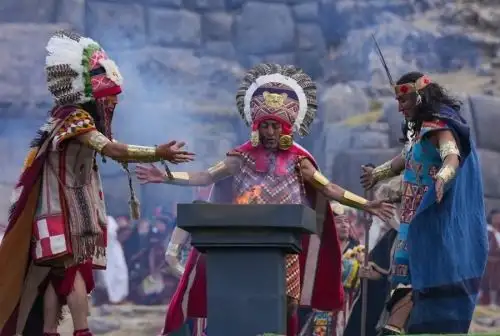
Fire is an emblematic symbol of transformation and purification. It represents rebirth and renewal.
In the context of Inti Raymi, the sacred flame symbolizes the solar cycle's continuity and the hope of a new beginning.
Coca leaves and chicha de jora play a highly important ritual role in Inti Raymi.
The coca leaf—considered sacred—is used to establish a connection with the divine and seek spiritual insight, while chicha de jora—a fermented corn-based beverage—symbolizes abundance and vitality, serving as a means of sharing and celebrating life.
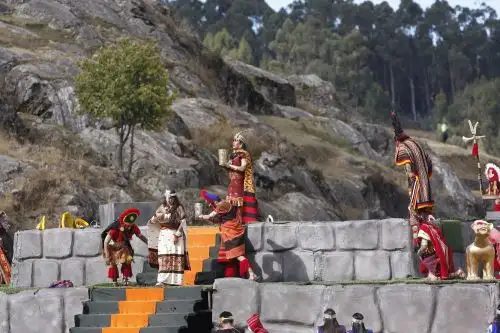
The spiritual dimension of Inti Raymi extends beyond historical reenactment. During the ceremony, every gesture, every offering, and every word carries a profound meaning that seems to transcend time and connect participants with the mystical.
The spirituality of Inti Raymi is experienced intensely in the atmosphere created during the festival.
The music, dances, and retelling of ancient myths help create a sacred space where the community comes together to celebrate its cultural identity.
Each ritual is intended to strengthen the bonds among individuals and with the land, reminding them of the importance of living in harmony with everything that surrounds them.
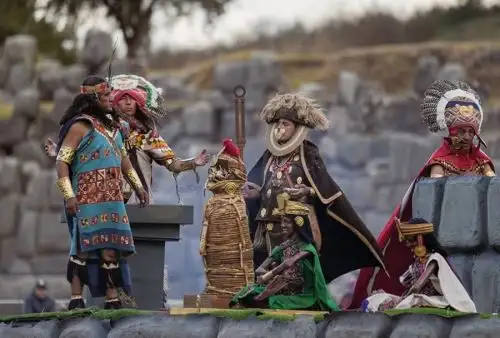
This spiritual connection is not only a tribute to the Sun God, but also a means of introspection and personal renewal.
By taking part in Inti Raymi, participants find an opportunity to reflect on the meaning of life, their interdependence with the environment, and their responsibility to preserve the traditions that shape their identity.
(END) LZD/MAO/MVB
Publicado: 24/6/2026