A complex of adobe enclosures with fine plaster finishes, built for the use of the Viru elite more than 1,500 years ago, was uncovered by a team of Peruvian archaeologists after three weeks of excavations on the Cerro Blanco slopes, in the Huancaquito Alto population center, in La Libertad region, northwestern Peru.
In enclosure 2, a small niche can be observed within the walls, with wall heights ranging between 2 and 2.5 meters.
It features very well-preserved floors surrounded by two benches. Spinning tools have also been found there, including a chalk cone used for spinning and several well-preserved spindle whorls.
For its part, enclosure 3 is the largest and would have been a very important courtyard.
It contains an altar or podium, initially accessed by a staircase that was later sealed to build a ramp.
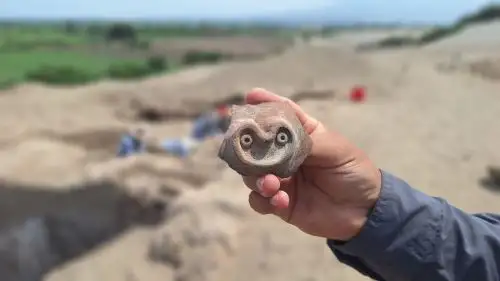
Similarly, a series of niches have been found that may have been used to store offerings; however, they may have been looted by grave robbers. Archaeologists were particularly struck by the discovery of the lid of one of them.
"We are looking at walls 70 centimeters thick and up to 2.5 meters high. That monumentality, associated with the materials we have found, leads us to propose that this was a residence inhabited by a member of the elite. Someone very important ordered the construction of this building, and although our excavation is very partial, it does give us insight into the use of the space," he indicated.
Another important detail that reinforces the researchers' thesis is that the Carolina huacas and the archaeological site known as Cerro Piñas are located in front of this residence, giving its main occupant a privileged view from there.
Similarly, behind Cerro Blanco lies the Huancaco Castle, a six-phase construction sequence from the same culture.
It is worth noting that there is evidence of a large Moche cemetery to the south of the site, although it has been heavily looted.
Clay model
One of the most important objects recovered by Feren Castillo and his team is a fragment of a clay model, whose base features cane latticework.
Similarly, it shows one of the corners formed by the walls, as well as a niche similar to the one in enclosure 2. Likewise, it is painted with a white and black band.
"This model is evidence of the representations made by the Viru culture as part of their construction planning between 100 and 700 AD," the University of Rennes researcher added.
New insights
The PAVI discovery would put an end to a long-standing debate over the culture that occupied the archaeological site, recorded as V-131 by researcher Gordon Willey in 1942 and as VV.94-11:1 by the Chavimochic Special Project.
Based on ceramic collections, researchers Ford and Willey proposed in 1949 that the site belonged to the Viru (Gallinazo) period; however, this hypothesis was challenged by Bennyhoff, who in 1952 suggested that the site was instead Moche.
"Thanks to our excavation and the elements we have found, we can state that the site was occupied during the Viru period, which confirms the thesis of researchers Ford and Willey and dismisses Bennyhoff's position," Castillo pointed out.
He said that at the end of the excavation he will submit a report to the Ministry of Culture, in which they will propose that the site be designated as the Cerro Blanco Archaeological Site.
Backers
At another point, Castillo thanked the institutions funding this work, including the Cine Chimu Cultural Center, the Municipality of Huancaquito Alto, and CReAAH at the University of Rennes (France).
Similarly, the project is supported by 13 ninth-cycle students from the Archaeology program at the National University of Trujillo, as part of their pre-professional internships.
He is accompanied by conservator Alex Clavo, archaeologist Oswaldo Ezeta, and bachelor's degree holder Christian Gonzalez.
A step toward tourism
The mayor of Huancaquito Alto population center, Milton Garcia, highlighted the findings by the Viru Valley Archaeological Project team, led by Feren Castillo.
Garcia noted that they underscore the site's tourism potential and that, in the future, it could be integrated with other attractions in Viru province.
He said it is important for the population, especially school students, to learn about the archaeological site so they can help protect it. Garcia committed to seeking support for more projects like this, which are highly important for strengthening the community's identity.
(END) LPZ/MAO/MVB