The
Ministry of Culture (Mincul) reported that the human remains of an adult individual, probably male, dating back approximately 1,400 years were found at Huaca Pucllana in Lima's Miraflores district.
The individual is believed to have been deposited as an offering during a closure ceremony for an underground canal associated with a ceremonial well.
Through the Huaca Pucllana Site Museum, Mincul reported that the archaeological context corresponds to the Lima culture and has been preliminarily dated to around 650 AD.
Therefore, the remains would be approximately 1,400 years old.
Based on its characteristics and location, the discovery provides new information about the ritual practices carried out during the pre-Hispanic occupation of Huaca Pucllana.
How were the remains found?
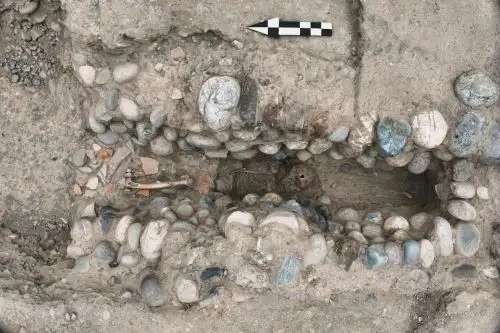
The individual was found lying lengthwise along the canal, oriented from north to south and resting on its left side.
The skull was facing west, with the individual's gaze oriented toward the pyramid and the sea.
This arrangement suggests that the individual may have been intentionally placed there as part of the structure's ritual closure.
Initial observations of the exposed pelvis and occipital crest indicate that the individual could be an adult male.
However, this identification must be confirmed through specialized physical anthropology studies.
These analyses will allow for a more precise determination of the individual's sex and age at death, as well as the identification of possible pathologies, trauma, health conditions, and other biological characteristics.
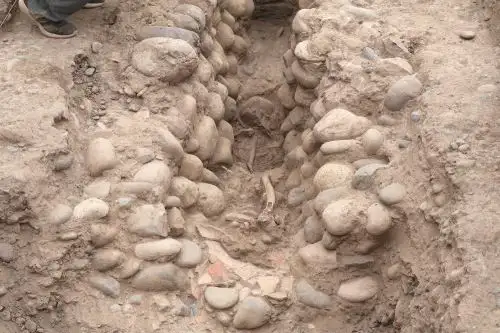
A ceremonial well built with rounded stones
One of the most significant aspects of this discovery is the architecture of the ceremonial well associated with the canal.
Unlike other structures known at Huaca Pucllana, which are characterized by the use of small mud bricks, this well was built with rounded stones.
This construction technique is unusual at the site and makes the discovery particularly significant for understanding the diversity of architectural solutions and ceremonial practices of the Lima culture.
The association involving the well, the underground canal, and the possible human offering reinforces the complex's ritual nature.
Further research
The human remains and archaeological materials found will provide an opportunity to further study closure ceremonies, the use of underground spaces, and the organization of Huaca Pucllana's ceremonial landscape.
The upcoming analyses will also seek to determine the individual's biological characteristics and provide a better understanding of the circumstances surrounding the person's death and subsequent deposition.
The study of the architecture, ceramics, animal remains, and other recovered materials will make it possible to reconstruct the sequence of use and closure of both the well and ceremonial canal.
(END) NDP/LIT/MVB
Publicado: 18/8/2026