18:00 | Barranca (Lima region), Apr. 20.
Researchers from the Caral Archaeological Zone, led by Ruth Shady, have discovered a complex architectural structure linked to astronomical observation at the Aspero Archaeological Site, an ancient fishing city of the Caral Civilization located in Supe Port, Barranca province, authorities reported Monday.
According to Caral archaeologists, the structure may have been used by specialists dedicated to recording astronomical phenomena and their relationship with the natural environment.
That knowledge would have helped plan productive activities such as fishing, shellfish gathering, and exchange with agricultural communities in the Supe Valley.
The discovery was presented as part of the commemoration of 21 years of research, conservation, and enhancement work at Aspero, an archaeological site occupied between 3000 B.C. and 1800 B.C.
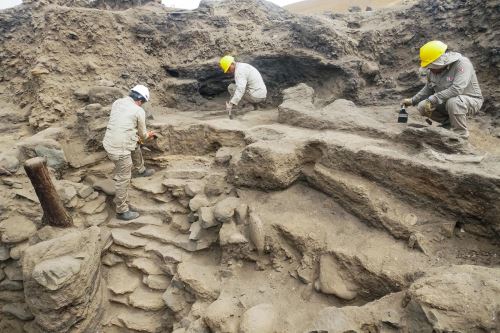
During excavations in the so-called Sector J1, archaeologists identified a structure strategically located near the settlement's main pyramidal buildings.
From that point, there is a view of the coastline and the lower part of the Supe Valley, which may have facilitated the monitoring of natural and astronomical phenomena.
Details and purpose
Aspero inhabitants used rounded stones and pebbles set with clay to build the structure, the site's chief archaeologist, David Palomino, told Andina news agency.
He added that it was designed in such a way that it casts shadows on the surface.
This was possibly intended to determine cycles, as well as movements of the sun, the moon, and other celestial bodies.
Palomino said the structure is located south of Aspero, in an area near the coastline. From there, observers could see both the coastal zone and the adjacent Supe River valley.
The archaeologist said the discovery confirms "the level of knowledge achieved by the Caral Civilization."
"This type of structure is present in the so-called Sacred City of Caral, as well as in other settlements of this civilization," Palomino indicated.
However, in this case, the distinctive feature is that it is a two-level structure, unlike those found in other areas influenced by the Caral society
He said that detail could be related to the site's proximity to the coastline, considering that Aspero was a populated settlement dedicated to fishing, where anchovy and shellfish were extracted for food purposes.
Although agriculture represented another food source for the settlement, he noted that water in the Supe River becomes scarce between April and November, with the riverbed drying up during the rest of the year.
Like settlements linked to the Caral Civilization, Aspero maintained interaction with other regions of what is now Peruvian territory, as shown by Amazonian and Andean elements found in tombs and homes, Palomino said.
The commemoration of 21 years since the start of research at Aspero will center on Raymi Fest, to be held April 24-25 in Supe Pueblo, in Barranca province.
Scheduled activities include participation by local residents and showcases of their cultural and productive traditions.
(END) FGM/MAO/MVB
Publicado: 20/4/2026