18:00 | Trujillo (La Libertad region), Sep. 14.
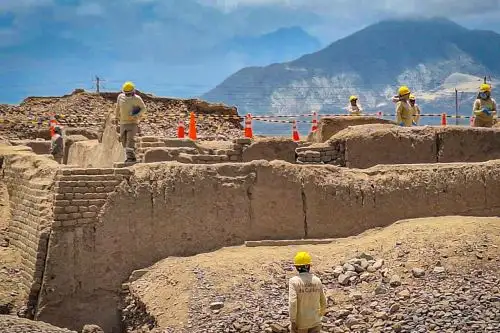
The intact Chimu funerary platform, discovered by Peruvian archaeologists at the Chan Chan Archaeological Complex, shows evidence of continuous activity and use.
The evidence would confirm that this civilization conceived of the firmament as an exact reflection of its territory: a setting where existence did not end, but continued uninterrupted after the final breath.
Jorge Meneses, the lead archaeologist of this research, told Andina News Agency that the platform where a principal figure and 37 companions were found was subject to constant manipulation, perhaps by the family or those who managed it, following the death of this member of the Chimu elite.
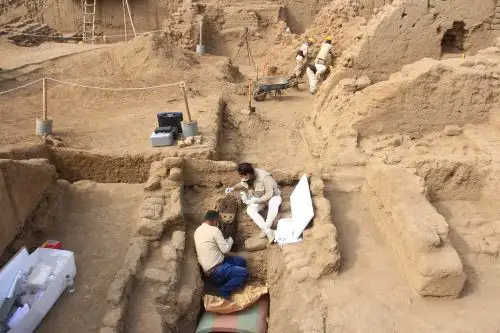
Evidence of this would be found in the main figure's chamber, where the partially altered skeleton was discovered: part of the skull, the jawbone, long bones, and some very thin skin tissue due to the passage of time.
"Unfortunately, we found a secondary (funerary) context, which means that we did not find it unaltered since it was deposited, but this does not mean that it was altered by looters," Meneses said.
"We must not forget that there is extensive evidence of post-mortem manipulation by members of the family itself or servants who provided services at the funerary platform," he indicated.
The researcher said there is a possibility that fragments of the main individual’s skeleton were removed to be used as amulets or relics by the family itself.
Another explanation is that it may have been partially removed, but the archaeologist said more evidence is needed to confirm that theory.
High-status platform
The funerary platform consists of a central chamber and two side chambers.
To reach the central chamber, measuring 1.2 meters wide and 5 meters deep, there is an entrance followed immediately by a staircase that allows one to descend approximately 2.5 meters into it, which also has an empty niche.
This chamber contained the remains of an individual who was found on what appeared to be a mattress made of red and yellow threads.
However, archaeologists believe it may actually have been textile material, of which only the threads have remained due to the passage of time.
Among that tangle of threads and on either side, objects that the principal figure may have used during his lifetime were found, such as ear ornaments, vessels, and metal emblems, beads, Spondylus shells, and metal decorations.
On either side, two individuals were found as well, one of whom had 10 Spondylus shells and one Conus fergusoni.
Meanwhile, the other was found with the elements reversed, that is, a single Spondylus shell and 10 Conus fergusoni, which could represent duality.
The wooden chest
One of the objects found that has most surprised the researchers is a wooden chest containing 20 finely finished textile pieces with embroidered figures.
The handle can still be seen and apparently was shaped like a Spondylus shell.
The mace heads stand out, whose bases are in poor condition; as well as some long objects covered with metal, whose tips have what appear to be cutting blades and which may have been up to 1.70 meters long.
Although they were initially thought to be tools, Meneses believes they could be staffs of power.
A wooden object was also found that may have been used as a grave marker and featured decorations.
The other chambers
The two side chambers measure 1.5 meters wide by 8 meters long and 3.5 meters deep below the working surface level.
The contents of both chambers were different; while one lacked skeletal remains and contained some weapons and metal emblems, the other has so far yielded 20 buried individuals.
Together with another 18 found at this funerary platform, this brings the total to 38.
Meneses indicated that the individuals accompanying the main chamber had valuable objects as well.
Sacred red
The specialist indicated that the main figure has red pigmentation on the jaw, while the other two have it on the skull.
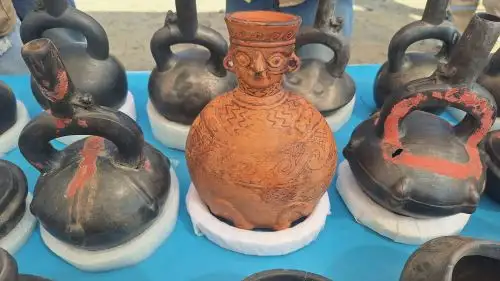
Vessels depicting figures with red-painted faces have also been found, so it cannot be ruled out that they may represent how these people's faces were painted when they died.
"It is quite unusual that only three people show this red pigmentation; there must be some connection, but at this stage of the research, we still cannot determine what role each of them played," he said.
The archaeologist indicated that DNA testing will be needed to determine whether the individuals who accompanied the main figure were relatives or not.
Ruler or elite member?
The literature reviewed on Chimu culture reveals that this society buried its rulers, the Chimo Capac, within walled complexes or palaces.
However, this funerary platform was found outside the Utzh An walled complex, but attached to the southern wall.
"That is why we believe he was not a ruler, but an important member of the complex Chimu social structure," archaeologist Jorge Meneses emphasized, while not ruling out the possibility that he was a ruler of a nearby valley.
First, it will be necessary to fully understand the context in which these events took place, because 600 years ago, during the Late Chimu period, it may have been a time of changes, and this platform could help define many concepts.
Meneses has more questions than answers, but he knows that this is the first time in the history of Peruvian archaeology that they could be obtained through a detailed study of this funerary platform.
Fabulous discovery
These findings were presented to the world on September 8 at Chan Chan, in the presence of Culture Minister Alberto Beingolea, La Libertad region authorities, and other prominent figures in archaeology, including Walter Alva, discoverer of the Lord of Sipan.
This research project has provided employment to 95 people, including technicians and assistants.
The excavation stage is expected to be completed in two weeks, followed by conservation work, after which the site will be covered to protect it from El Niño phenomenon.
(END) LPZ/MAO/MVB
Publicado: 14/9/2026