01:07 | Huarmey (Ancash region), Jun. 27.
The discovery of Peruvian Hairless Dog remains at the Castillo de Huarmey Archaeological Complex in Ancash region constitutes one of the oldest and best-preserved examples of this iconic breed native to Peru.
Likewise, it provides new clues about its possible links to ancient Mesoamerican cultures, Polish researcher Milosz Giersz stated.
Speaking to the Andina News Agency, the archaeologist said the discovery at the Wari site of Castillo de Huarmey is exceptional because of the preservation conditions offered by the Peruvian desert, where skeletal remains and even mummified animals have been recovered.
"This discovery is significant because it shows that the Peruvian Hairless Dog is not merely a modern symbol of Peru, but that this breed was already part of the lives of Andean societies more than 1,000 years ago," he indicated.
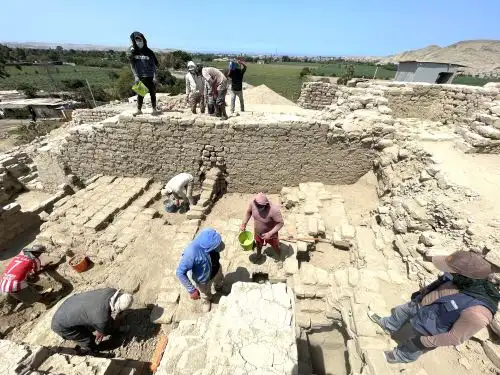
Giersz explained that archaeological investigations uncovered the remains of several dogs associated with the major Wari center at Castillo de Huarmey, including at least three individuals with anatomical features consistent with the Peruvian Hairless Dog, such as the congenital absence of certain teeth—one of the breed's distinguishing characteristics.
One of these specimens was found naturally mummified and was dated to between the 7th and 9th centuries AD, during the early stages of the Wari presence in Huarmey.
According to the researcher, it is one of the oldest archaeological specimens to have been conclusively identified through osteological and isotopic analyses.
Possible links to Mesoamerica
The expert said the discovery also lends support to hypotheses about a possible link between the Peruvian Hairless Dog and the Mesoamerican Xoloitzcuintli.
"There is a very interesting hypothesis that this breed may have had early links to Mesoamerica, where a similar dog existed, too," Giersz remarked.

However, he clarified that there is still no definitive evidence of an exchange route between Mexico and the Peruvian coast, adding that further ancient DNA studies will be needed to confirm this theory.
During that period, contacts existed between Andean societies and Mesoamerican peoples through the exchange of metals, Spondylus shells, and other exotic goods, Giersz added.
Dogs held special status in the Wari world
Analyses of more than 300 recovered bones revealed that some dogs received special treatment within Wari society.
Giersz explained that some specimens were buried alongside high-ranking individuals and likely served ritual and symbolic functions.
One of the mummified dogs even had traces of cinnabar on its face—a pigment associated with elite funerary rituals.
"This shows that the relationship with these animals was far more complex than one based solely on practical utility," he stated.
The archaeologist also noted that dog paw prints were found on adobe bricks used to build the huaca at Castillo de Huarmey, providing evidence of the animals' everyday presence at the site.
Castillo de Huarmey and Wari female power
Giersz noted that Castillo de Huarmey has become one of the most important archaeological sites for understanding the political and social organization of the Wari Empire approximately 1,200 years ago.
The researcher recalled that in 2012, the Polish-Peruvian team discovered the first intact royal Wari mausoleum.
The remains of 64 high-ranking women were recovered there alongside more than 1,300 artifacts of extraordinary quality, including textiles, jewelry, tools, and ceramics.
He said the finding prompted researchers to reassess the role of women within the Wari civilization.
It provided evidence that women held positions of considerable political and religious power.
"The so-called Wari Queen of Huarmey has become one of the most powerful women of the pre-Hispanic world known to date," he underscored.
Long-term research
The researcher said a new five-year research program is currently underway, involving excavations and studies at more than 20 archaeological sites associated with the Wari period across Huarmey province, from the coast to the high Andean regions.
The aim is to reconstruct the exchange networks, contact routes, and origins of the populations associated with the Wari Empire, as well as to gain a better understanding of how this society functioned.
According to the researcher, the evidence recovered so far indicates that Castillo de Huarmey served as a major administrative, funerary, and elite craft production center of the Wari Empire.
"From the perspective of Castillo de Huarmey, it was a period of great prosperity and stability," he concluded.
(END) MAO/MVB
Publicado: 27/6/2026