Discoveries resulting from archaeological research in Caral continue as the 32nd anniversary of the start of these investigations is marked this month. Recently, anthropomorphic figurines were found that may represent a couple and the duality that characterizes nature.
Speaking to Andina News Agency, the Deputy Director of Research and Conservation at the Caral Archaeological Zone, Marco Antonio Machacuay said the figurines "could reflect the cosmology and ontology" of this civilization's members.
The characteristics of these figurines may shed light on their thinking, as well as their views on nature and their existence as human beings, the researcher said.
Machacuay noted that this possibility stems from the fact that this type of figurine is not found in many places.
The two figurines were discovered in a structure near the Main Residential Complex of the Sacred City of Caral.
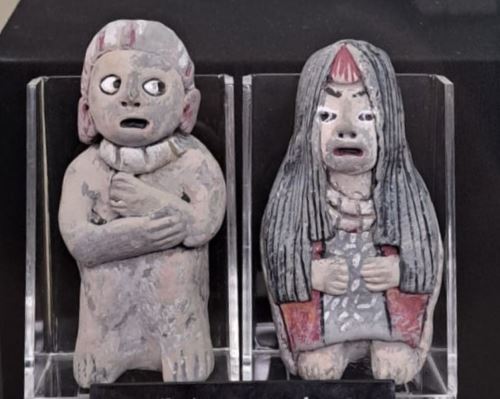
Both figurines are made of clay. One has masculine features and what appears to be a loincloth, while the other has feminine features, indicated by cone-shaped breasts.
Female symbolism
The period in which these figurines were made is estimated to be between 3000 and 1800 BC.
After this period, the production of figurines of this kind gradually incorporated color, with female figures appearing consistently.
"They gradually become an important and symbolic element that has much to do with cosmology and their ceremonial rituals," Machacuay said.
Colors were added to these figurines from the aforementioned period onward, particularly to their clothing and personal ornaments.
"In the early period, they (the figurines) were much more detailed in terms of everyday life, depicting men, women, animals, and plants, but in white or without color," the archaeologist explained.
After 1800 BC, colors began appearing both on figurines of this type and in wall decorations. This can be seen in Caral, as well as at the archaeological settlements of Vichama and Peñico, which are also associated with this civilization.
Exhibition at the Ministry of Culture
Due to their delicate condition resulting from their age, the aforementioned figurines were displayed for a short period as part of the exhibition on Caral currently being held at the Ministry of Culture's headquarters in Lima.
Other figurines dating from later periods continue to be displayed, showing more colors and details, in addition to features that indicate status differences.
Thus, the male figure displays a certain visual impairment and simple attire, which archaeologists interpret as evidence of a relationship between a female master and a servant.
The commemoration of the 32nd anniversary of the start of research in Caral will focus on Caral Raymi. It will take place on October 23 and 24 at the Sacred City.
On the first day of the event, a ceremony honoring Pachamama will be held.
At night, the site's architectural structures will be illuminated with lights of different colors.
A cultural festival and a tour of the Sacred City are scheduled for Saturday, October 24, along with a demonstration of Peruvian Paso horses and scissors dancers, led by Qori Sisicha, an Ayacucho performer of this musical expression of Andean folk culture.
Caral is located four hours north of Lima, at kilometer 184 of the North Pan-American Highway, in Supe district, Lima region.
Publicado: 14/10/2026