President of the Republic Keiko Fujimori stated from Tumbes that Peru has now "a government that is out in the field"—referring to the fact that the administration is present across the country, working directly with the population to address their needs.
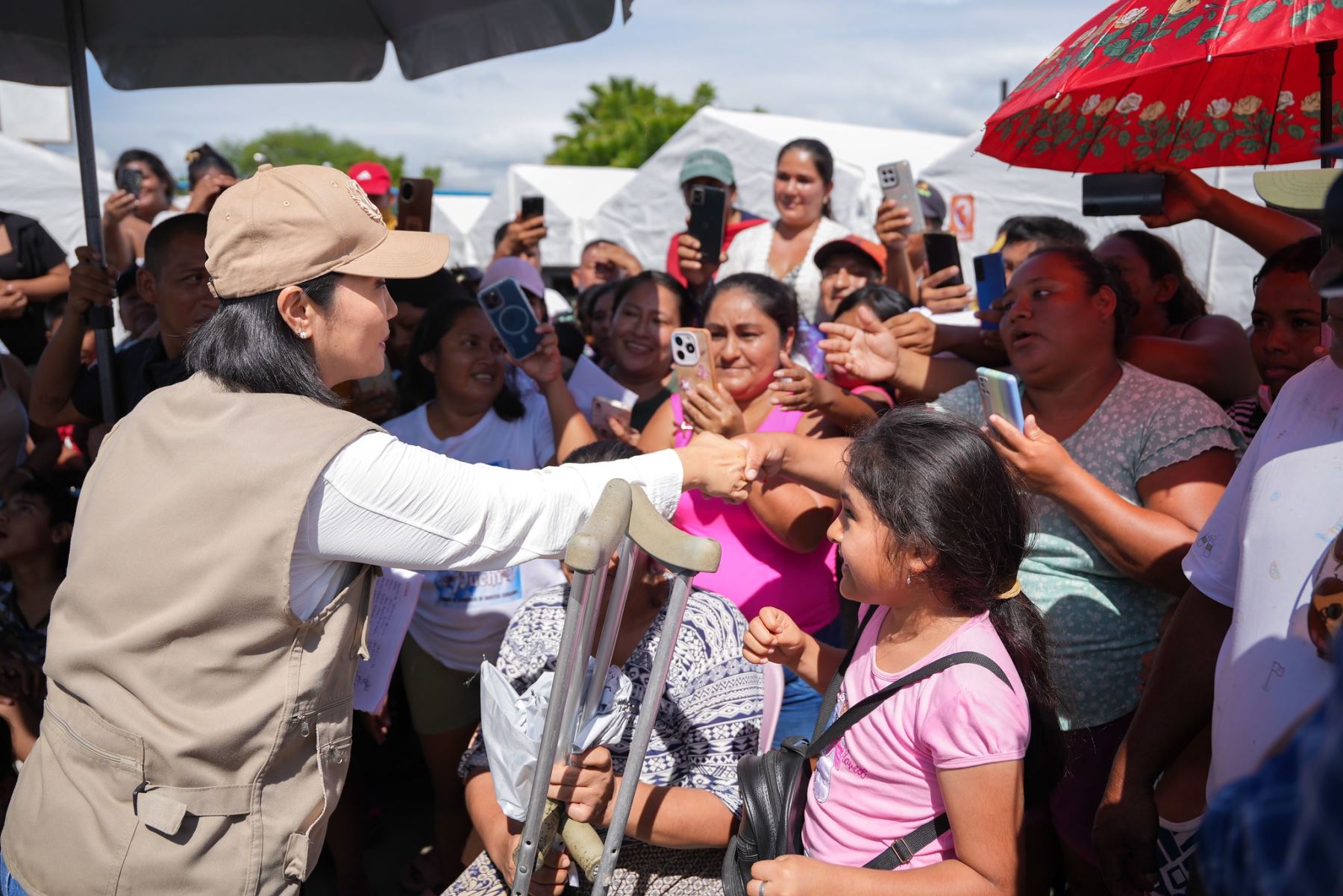
She made these remarks after visiting shelters, a settlement affected by flooding, and a field hospital in the Tumbes region, where she heard the population’s needs firsthand and announced actions to address them.
This working visit is part of the government’s immediate and coordinated response to the intense rainfall caused by the El Niño phenomenon.
“We have a government out in the field. Whenever a problem has arisen, machinery has been deployed immediately. Water pumps are on-site to provide assistance,” the President stated from the Villa Primavera shelter, located in the Aguas Verdes district, Zarumilla province.
During the first stop on her agenda—marking her 28th trip to the interior of the country—the Head of State highlighted the deployment of the Armed Forces and the National Institute of Civil Defense (INDECI), as well as the coordination with regional and local authorities to provide aid to those affected.
She also warned that rainfall could intensify in the coming months, emphasizing the importance of maintaining preventive measures to protect the population.
“This phenomenon is only just beginning, which is why we must take care,” she told the public, reaffirming that the executive branch will continue to mobilize resources, equipment, and personnel to respond to emergencies.
At the aforementioned shelter, the leader received requests from 120 families affected by the floods in the Puerto Perú settlement, who asked for the construction of a riverbank defense structure that would allow them to return to their homes.
In response, she announced that a technical team would be sent next week to assess the risk conditions and determine whether building such infrastructure is feasible, or if it will be necessary to permanently relocate the families to a safer area.
“Depending on what they tell us—if they advise that it is better for you to be relocated—we will send the Minister of Housing to work on providing housing for each of your families as part of a relocation process,” she stated.
As an initial measure, the president ordered the identification of those affected to ensure that assistance reaches those who truly need it. “We are going to draw up a registry now,” she indicated.
She also proposed moving them temporarily to another nearby shelter that has proper roofing, in order to provide better protection for children and the elderly against the sun and rain.
“If we know that this area is at risk, then we will find a safer place for everyone. This phenomenon is only just beginning, which is why we must take care of ourselves,” she said, warning of the danger posed by further rainfall.
In the same vein, she highlighted support measures for the agricultural sector in the face of the floods. “Today, 75 water pumps will be delivered to our fellow farmers. Another 230 water pumps have already been distributed,” she emphasized.
El Gran Chilimasa shelter
Subsequently, President Keiko Fujimori visited the El Gran Chilimasa Educational Institution (No. 098), located in the Nuevo Aguas Verdes settlement, where she inspected the tents set up in the sports areas to provide temporary accommodation for families affected by the floods. During the visit, the head of state inspected the condition of these spaces and received an update on the support provided by the Peruvian Army—in coordination with regional and local authorities—to ensure humanitarian assistance reaches those affected.
The head of state also visited classrooms at the school and greeted primary-level students, who were continuing their lessons as usual, even though part of the educational facility is being used to manage the emergency response.
While there, the head of state heard a request from local authorities to strengthen medical services and ensure 24-hour care. In response, she indicated that she would coordinate with the Minister of Health and the regional governor to take the necessary steps to address this need.
Assistance for residents of El Canario
The third stop took place in the El Canario settlement—also located in Aguas Verdes—where President Fujimori toured areas affected by the rainfall and gathered requests from residents regarding damage to their homes and the lack of property titles.
After listening to the local residents, she announced that Minister Marco Vinelli would coordinate with the Minister of Defense, Rafael Belaunde, to identify families who lost their roofing sheets, with the goal of channeling the necessary assistance to them.
“There has been heavy rainfall, and several families have lost their roofing sheets. Minister Vinelli will coordinate with the Minister of Defense to compile a list of the affected families,” she stated.
The President also addressed a request from residents who have been waiting for approximately ten years for the formalization of their land titles. She announced that she would seek the intervention of the Agency for the Formalization of Informal Property (Cofopri) to evaluate and expedite this process. “I will ask the head of Cofopri to come here so that the property titles—which have been pending for ten years—can be issued,” she affirmed.
During her visit, the Head of State also addressed concerns regarding flooded areas and health risks, particularly the potential spread of dengue fever.
In this context, she called for intensified cleanup efforts and encouraged participation in vaccination programs.
“Please, take part in all the vaccination programs. (...) It is very important—first, the Army will come here to carry out cleanup operations, and then, young people should go and get vaccinated,” the President urged.
Field hospital
Finally, the President inspected a field hospital set up at the María Mafalda de Lama educational institution. She assessed the quality of care provided and acknowledged the coordinated efforts of the various institutions that worked together to implement the facility in response to emergencies caused by the El Niño phenomenon.
During the visit, the Head of State expressed her gratitude to the United States government for the donation of three field hospitals, intended to strengthen healthcare capacity in the regions of Tumbes, Piura, and Lambayeque.
She also highlighted the participation of the Ministry of Defense, the Peruvian Army, the Ministry of Health, the regional government, and the educational community—the latter having provided part of its facilities to enable the operation of this temporary infrastructure.
“Difficult times lie ahead. We are only just beginning. But knowing that you are already prepared gives me a sense of reassurance—the knowledge that the population will receive the care they deserve,” the President stated, addressing doctors, nurses, and specialists.
In this regard, she expressed her appreciation for the healthcare personnel, emphasizing that the response to emergencies must combine professional competence with a human, compassionate approach toward patients.
The Head of State also recalled the requests she received during her visit to Villa Primavera, reiterating that specialists will be sent to assess whether the construction of riverbank defenses could allow those affected in Puerto Perú to return home, or if a permanent relocation is the appropriate course of action.
Furthermore, she reaffirmed that her administration will continue to implement concrete measures to address the needs of the population, particularly in regions most vulnerable to heavy rainfall.
“What matters here is that there is a government that responds and provides support—as I mentioned yesterday, marking our 100th day in office. We focus not on rhetoric, but on delivering results,” she emphasized.
Finally, President Fujimori inspected the equipment installed at the Malecón El Beso in the Tumbes district, which includes a water diversion unit, motor-driven pumps, and a sluice gate system designed to drain rainwater into the Tumbes River.
The Head of State was accompanied by the Minister of Defense, Rafael Belaunde; the Minister of Agrarian Development and Irrigation, Marco Vinelli; the Minister of Health, Luis Dyer; and various regional and local authorities.
More from Andina:
Published: 11/6/2026