17:04 | Huaura (Lima region), Jul. 8.
A ritual offering approximately 3,800 years old, linked to the construction of a platform at the Main Public Building in Peñico's urban center, was discovered by researchers from the Ministry of Culture in Huaura province, Lima region.
The discovery provides new evidence of the continuity of the Caral Civilization's cultural tradition at Peñico after the decline of its main cities.
The discovery was made by specialists from the Ministry of Culture's Caral Archaeological Zone, under the direction of archaeologist Ruth Shady.
The offering was found during excavations in subsection B1-B3 of the Main Public Building.
It is believed to have been deposited as part of a consecration ritual associated with the construction of a new platform.
Archaeologists recovered a set of 43 objects made of wood and bone. Several of them feature incised designs and signs of exposure to fire.
Among the objects are representations of mythical figures, anthropomorphic figures—including a female figure and possible authority figures—as well as birds, snakes, tadpoles, and various geometric and abstract motifs.
The pieces feature cavities intended for the inlay of minerals or semiprecious stones, a characteristic that reinforces their ceremonial use.
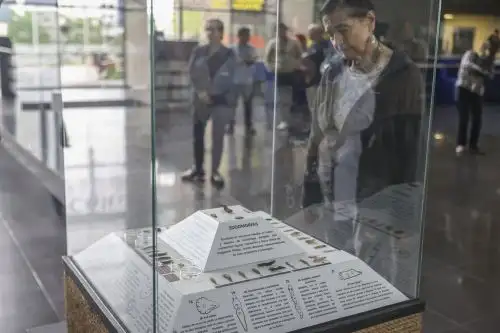
The assemblage includes three chrysocolla beads, three chrysocolla fragments, and fragments of beads made from terrestrial gastropod shells.
It also includes nine eye representations crafted from mollusk shells—believed to have formed part of sculptures—and eight small objects whose function remains under study.
The offering was found inside a small space measuring just 22 centimeters in length. It was bounded by rounded stones arranged in a semicircle and covered by a large stone.
According to specialists, this archaeological context constitutes clear evidence of a carefully planned ritual act and of deep symbolic significance for Peñico society.
Peñico Archaeological Site Chief Mauro Ordoñez told Andina News Agency that the objects found include ornaments bearing the design known as the "Eye of God."
He noted that the motif is also found in Caral—whose peak predates that of Peñico—as well as in the Amazon.
The archaeologist said this iconography shows the links Peñico maintained with other regions of what is now Peruvian territory.
He said this reflects the "exchange and complementarity" maintained by Peñico, as evidenced by findings showing the use of materials and iconography from regions far from the coast.
In that context, he highlighted previous findings of bird feathers, such as those of parrots and macaws, as well as graphic representations of monkeys—animals native to the Amazon.
Ordoñez said these interconnections with other geographic areas are reflected in the presence of spondylus shells, a mollusk whose habitat lies in the equatorial Pacific.
32 pieces on display
All of these objects were discovered in December 2025 and have undergone cleaning and conservation procedures in recent months.
As a result, 32 pieces are on display starting today at the Culture Ministry's headquarters, while the remaining ones continue to undergo preservation work.
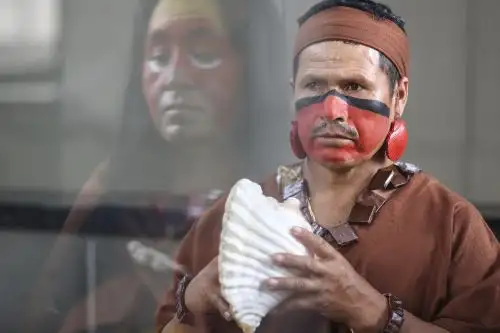
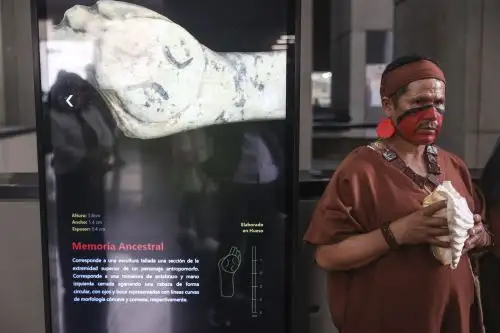
The challenge of observing the details of pieces measuring just over 20 centimeters is addressed through 3D virtual reproductions accessible via a touchscreen.
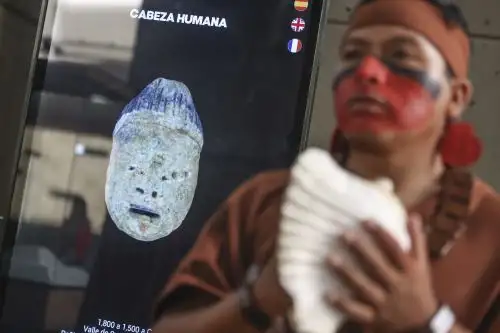
Through that module, visitors can enlarge the pieces to examine in detail the features of each one, including graphic designs, grooves, traces of red paint, and other aspects.
This makes it possible to see that some of these objects were exposed to fire, which Culture Ministry specialists believe may have formed part of a ceremonial or ritual act.
In the same room where the unearthed pieces and their interactive visual reproductions are displayed, there is also a virtual reality module that allows visitors to walk through Peñico's main public building. It immerses them in a ritual honoring the moon, accompanied by the sound of pututos.
The presentation of the unearthed objects was accompanied by an invitation to the Peñico Fest, a celebration marking nine years since research began at the site, scheduled for Saturday, July 11.
Ordoñez said the event will feature activities involving the participation of Huaura residents.
The event will also feature competitions among educational institutions highlighting aspects of the area's ancestral culture, as well as a fair featuring local producers.
(END) FGM/MAO/MVB
Published: 7/8/2026