“Popular traditions—with their symbols and dynamics, imbued with the values of Christian communion and solidarity—are an invaluable treasure of sound teachings, especially for the new generations,” stated Pope Leo XIV in Cusco today.
The Holy Father emphasized this during a homily delivered at a gathering with the faithful and representatives of popular piety on the esplanade of the Sacsayhuamán archaeological park—the first event of his apostolic visit to the city of Cusco.
In this regard, he noted the importance of young people participating in these activities, and stressed that their contributions should be welcomed and valued through listening, cooperation, and—when necessary—updating.
“The future of these customs does not lie solely in preserving what has been received, but also in passing it on in a living way. Each generation receives an inheritance and bears the responsibility of passing it on enriched and renewed, without fear of forging new paths or utilizing new tools,” he said.
“Rather, it is essential to safeguard the core of this formation: for instance, by helping young people learn about and delve deeper into the history of salvation and the lives of the saints, explaining the Christian significance of festive occasions, sharing the Word of God with them, and teaching them how to celebrate their faith within the Church,” he pointed out.
“The goal is to convey, through these traditions, a living experience of the Christian life—one that constantly grows and renews itself around the altar, where the Eucharist serves as the center and source of our existence,” he expressed.
At another point, the Bishop of Rome remarked that popular devotion in Peru is also deeply Marian. He noted that this is evidenced in the Vatican Gardens, where, last year, the Holy Father blessed a mosaic representing the various titles under which the Virgin Mary accompanies the Peruvian people—sharing in their joys and sorrows, and teaching them to hold onto hope.
At the beginning of his homily, the Supreme Pontiff publicly expressed his gratitude to the late Archbishop of Cusco, Monsignor Richard Daniel Alarcón Urrutia, who recently passed away and who had helped prepare for the Holy Father’s apostolic visit to the "Imperial City."
“As we begin this gathering, I would first like to express my gratitude to God for the life and ministry of Monsignor Richard Daniel Alarcón Urrutia, Archbishop of Cusco, who worked so hard for this visit and who had hoped to be here to welcome us,” said the Pope.
“Together with all my brother bishops, I offer my prayers for his eternal rest, asking our Lord Jesus Christ to grant him the reward of the righteous, and to all those who mourn his absence, the consolation that springs from faith in the Risen One,” the Vicar of Christ stated before the multitude of the faithful gathered on the esplanade of Sacsayhuamán.
Tribute to the Virgin, Queen of Bethlehem
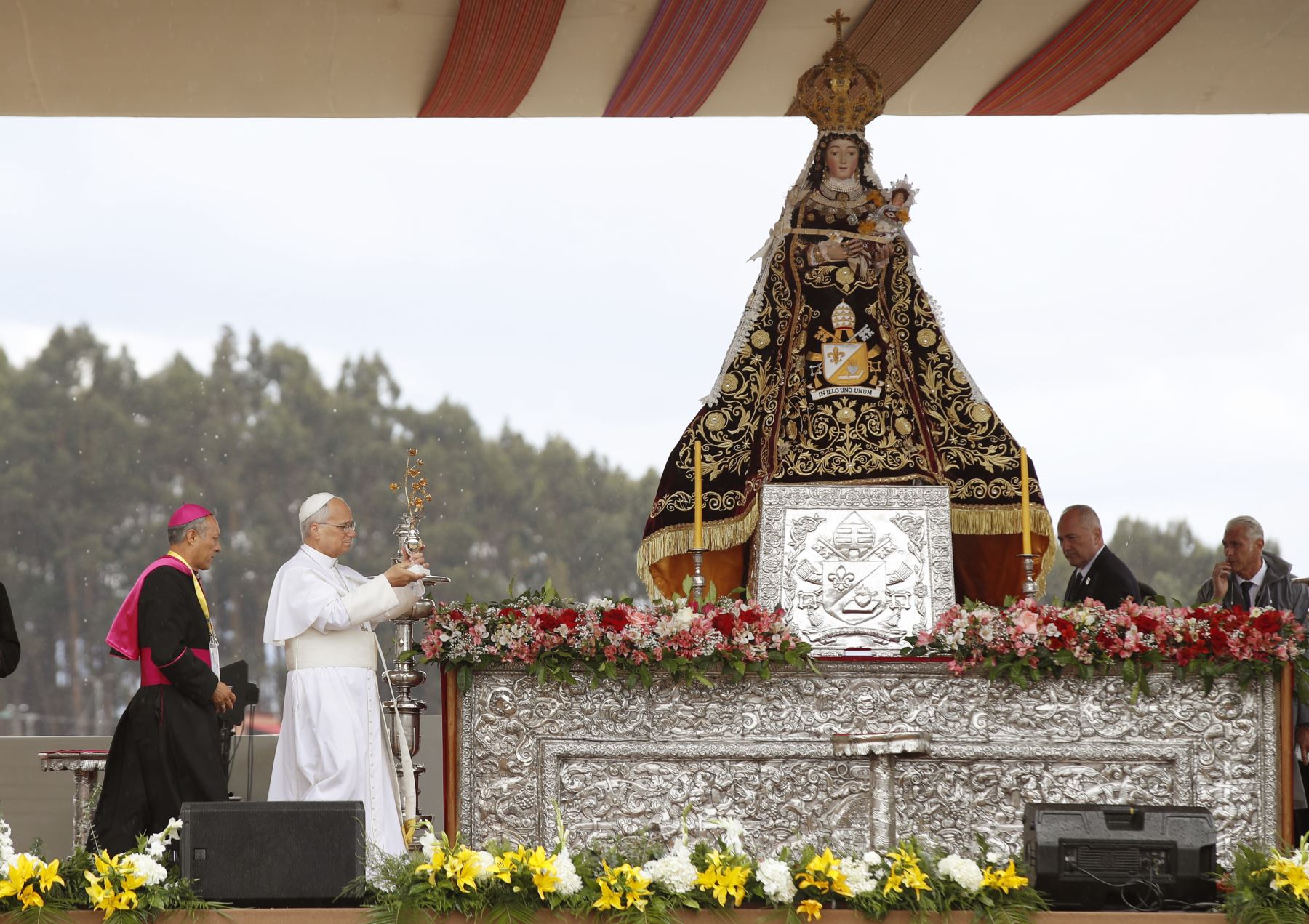
Following his homily, the Holy Father paid tribute to the Virgin, Queen of Bethlehem—the protective mother of Cusco—accompanied by the new Archbishop of Cusco, Monsignor Lizardo Estrada Herrera.
This marks the second visit by a Vicar of Christ to Cusco and the esplanade of the Sacsayhuamán Archaeological Park. In February 1985, the then-Pope John Paul II visited the site, where he also met with a vast crowd of the faithful—both from Cusco and from across Peru and other nations.
Below is the complete homily of Pope Leo XIV during his meeting with the faithful and representatives of popular piety at Sacsayhuamán.
Dear brothers and sisters:
As we begin this gathering, I would like, first and foremost, to express my gratitude to God for the life and ministry of Archbishop Richard Daniel Alarcón Urrutia, Archbishop of Cusco, who worked so hard for this visit and who longed to be present here.
United with all my brother bishops, I offer my prayers for his eternal rest, asking Our Lord Jesus Christ to grant him the reward of the just, and to all those who mourn his absence, the consolation that springs from faith in the Risen One.
The beauty of this place, which welcomes us this morning, is undeniable. Sacsayhuamán, like an altar of stone, rises toward the Andean sky—a place where, in ancient times, people ascended in search of the divine.Yet, our Christian faith has taught us that it is, in fact, God who descends in search of His sons and daughters. He enters a well-disposed heart, asking for a courageous and simple "yes"—like that of the Virgin Mary—which changed history forever.
Indeed, we began our liturgy with the antiphon: "Hail, Holy Mother, Virgin, Mother of the King, who rules heaven and earth forever and ever." And the Gospel passage we have just heard reminds us of Mary’s joy as she said "yes" to the angel, becoming the Mother of God and bringing Jesus into the world.
Both texts invite us to see the Virgin Mary as the one who leads us to an encounter with Christ.She herself awaited Him as the Messiah, within a devout family where her parents taught her to pray, to meditate on the Word of God, and to live according to the law of the Most High.
In this way, she found herself prepared for the encounter with the Lord: attentive and present, capable of recognizing His voice in the angelic messenger—His envoy—and of accepting the challenge of a unique mission for the salvation of humanity.
The Lord came to speak to her in her own home, in Nazareth—within the setting of her daily life and among her loved ones—in an environment rich with symbols she knew well, in her own language, and through the signs of her own culture.
This is how God acts. He seeks the most fitting ways and moments to draw near to us, so that we may all encounter Him, understand His words, experience conversion, and attain salvation.
Throughout the millennia, this mystery has unfolded anew in the most diverse contexts, yet always with the same willingness of the Almighty to become small for our sake—to speak to us and welcome us.
One of the most beautiful ways in which this has taken place is through popular piety.In such expressions, the memory of ancestors, the faith of families, love for Jesus Christ, trust in His Holy Mother, and the veneration of the saints are articulated through music, dance, imagery, and many other manifestations deeply rooted in the history and identity of a people.
Thus, a religious feast, a pilgrimage, or a procession is not merely a cultural display; behind every image, every hymn, every vow, and every sign lies a community of hearts seeking God—and a friendly voice from heaven that responds and draws near.
The goal, therefore, is to live out these traditional practices as opportunities for encountering and proclaiming the Lord—first within parishes, confraternities, and movements, and subsequently reaching out to the world as those who, having been evangelized, are now sent forth to evangelize: to proclaim the Risen Christ, ever ready to bear witness to the joy of knowing the Gospel and living it out through love for God and neighbor.
For this reason, Pope Francis has defined popular piety as a true expression of the spontaneous missionary action of the People of God, and as a manifestation of a life of faith, hope, and charity—a life animated by the action of the Holy Spirit, who has been poured into our hearts.
However, there is another aspect of the Gospel account we have just heard upon which I would like to reflect: the communal context in which the mystery of the Annunciation takes place.As we have noted, Mary’s faith matures as she lives within a community; even after the Annunciation, she continues to share her daily life with the brothers and sisters around her.
Her encounter with God does not isolate her or distance her from others; on the contrary, it makes her the guardian of a gift—a gift that grows within her for the good of all: for her fellow citizens and for all of humanity. Faith does not separate; rather, it unites us with God and with one another.
This is especially important in an age like our own—an age marked by divisions, wounds, mistrust, and circumstances that make it difficult for men and women to recognize one another as members of a single family, as sons and daughters of the same Father.
In this context, religious traditions can be of great help, as places to gather in the light of faith and love. A procession can make those who think differently walk together; a pilgrimage can bring together entire families; a celebration can bring together a community; A patron saint's day can become an opportunity to reconcile, ask for forgiveness and start again.
And this is a sign that can go far beyond the limits of a small city or region, helping to spread a culture of coexistence, mutual care and peace throughout the world.
That is why I invite you to make these holidays a school of fraternity and charity, in which you work, pray, have fun together and also take care of those who are in need, so that the joy belongs to everyone and everyone can experience it united before God.
Popular traditions, with their symbols and dynamics impregnated with values of communion and Christian solidarity, are an invaluable treasure of good teachings, especially for new generations.
In this sense, it is important that young people participate in the activities and that their contribution is welcomed and valued through listening, cooperation and also updating when necessary.
The future of customs lies not only in preserving what has been received, but also in transmitting it in a living way. Each generation receives an inheritance and has the responsibility of returning it enriched and renewed, without fear of opening new paths and using new tools.
Rather, it is important to take care of the essence of formation: for example, to make known and deepen with young people the history of salvation and the lives of the saints, to explain to them the Christian meaning of festive moments, to share with them the word of God, to teach them to celebrate faith in the Church.
It is about transmitting through traditions a living experience of Christian life that grows and is constantly renewed around the altar, where the Eucharist is the center and source of existence.On this path Mary occupies a special place.
Popular devotion in Peru is also deeply Marian and this is evident in the Vatican gardens, where last year I blessed the mosaic that represents the different devotions with which Mary accompanies this people, knows their joys and sorrows and teaches them to have hope.
Likewise, it is wonderfully remembered by the hymn Hanaq pachap by the missionary Pérez Bocanegra, which praises and invokes the Virgin through poetic metaphors that are both theologically profound and concrete, close to Andean culture and life.
This hymn, together with the masterpiece of the church of San Pedro Apóstol de Andahuaylillas and other testimonies of a creative and attentive proclamation, shows us how each devotion finds its meaning when it gathers everyone around Jesus and, following in his footsteps, takes us to heaven.
That is why I would like to entrust the Virgin Mary, queen of Bethlehem, protective mother of Cusco, with a path of renewal of popular devotion.In one more moment, spiritually united, we will do it together with the delivery of the Golden Rose, asking him to keep us in his heart, to grant peace to this land, to give strength to those who suffer and to grant us all the grace to walk together in the love of his son.
This is what we ask for. So be it.
More from Andina:
Published: 11/15/2026