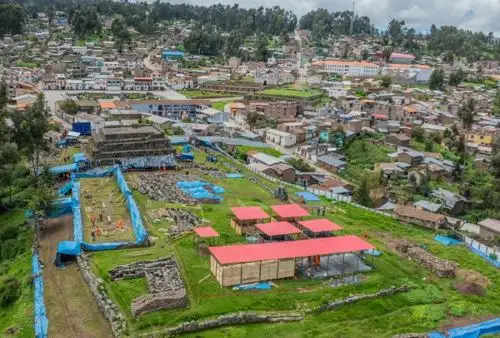
New and significant archaeological discoveries at the pre-Hispanic Vilcas Huaman complex are surprising researchers and reinforcing the historical value of this ancient Inca capital in Ayacucho region.
But this is not the only significant discovery.
In areas such as the Kallanka, evidence was found of prolonged human occupation spanning from the Inca era to later periods.
Among the remains discovered are postholes from wooden structures, ancient floors, copper artifacts, and seashells.
The latter are considered clear evidence of trade between the highlands and the coast, highlighting the existence of complex economic networks in pre-Hispanic times.
Likewise, archaeologists identified a sophisticated underground hydraulic infrastructure composed of leveling terraces, drains, and channels that enabled efficient rainwater management.
This system not only supplied nearby agricultural areas, but could even date back to cultures that predated the Incas, broadening the site's historical scope.
Specialists emphasize that these discoveries not only enrich knowledge about the political, social, and economic organization of the Andean world, but also consolidate Vilcas Huaman as one of Peru's most important archaeological centers.
Research efforts are continuing and promise to keep revealing secrets of a civilization that, centuries later, still has much to tell.