"We cannot stop the movement of tectonic plates, but we can build a better-prepared society," said
The expert underscored the need for Peru to prepare adequately for the imminent occurrence of a major earthquake, like those recently recorded in various South American countries.
"Being prepared means building safely, knowing which areas are at greatest risk, identifying safe places, taking part in drills, having a family emergency plan, and knowing how to act before, during, and after an earthquake," Tavera noted, as the public remains on alert following recent earthquakes in the region.
La Guaira was the Venezuelan city most affected by the double earthquake. (Photo: AFP)
A 7.4-magnitude earthquake also struck Colombia in August and claimed the lives of 330 people.
In Peru, a magnitude 7.2 earthquake occurred on August 20 and was felt in five regions, but caused no deaths.
Tavera explained that these countries are part of the so-called Pacific Ring of Fire, a vast region where a large part of the planet's seismic and volcanic activity is concentrated.
Along the western edge of South America, the Nazca Plate moves eastward and subducts beneath the South American Plate, he added.
"In Peru, this process occurs at an average rate of 6 to 7 centimeters per year and constitutes the main source of seismic activity," the scientist noted.
He warned that although it is possible to identify areas where conditions exist for major earthquakes to occur, "it is currently impossible to determine precisely the date, time, and place" where they will take place.
"Therefore, rather than trying to predict it, we must prepare for what we know will happen. Peru is a seismically active country, and the next major earthquake will occur someday. The truly important question is what we are doing to reduce its consequences," the researcher pointed out.
Tavera noted that, in addition to constructing safe buildings, identifying risk areas, and participating in drills, it is also necessary to "use scientific information to make better decisions about our cities and infrastructure."
"We cannot stop the movement of tectonic plates, but we can build a better-prepared society," he added.
Possible locations where an 8.0-m earthquake could occur
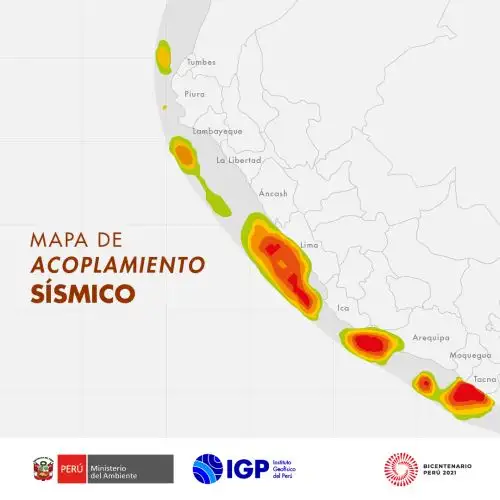
During his recent participation in the "Earthquake and Tsunami Preparedness and Response" working group, held at Congress, the IGP head reported that Peruvian researchers have identified three areas where earthquakes of 8.0-magnitude or higher could occur.
- Off the central coast, an 8.8-magnitude earthquake could occur.
- Off Nazca and Chala, an 8.0-magnitude earthquake could occur.
- Off the coasts of Moquegua and Tacna, an 8.0-magnitude earthquake could occur.
Added to this is an area beyond Peru's borders that could affect the country's southern region.
"In joint research conducted with colleagues in Chile, a fairly large area in the north of that country has been identified where stress is accumulating, and an earthquake of magnitude greater than 9.0 could occur, repeating the 1877 scenario," the expert pointed out.
During his participation in the working group, he referred to the popular belief that "small earthquakes help release energy" and explained why this statement is inaccurate.
"Earthquakes of magnitude 6.0 rupture an average area of 10 kilometers, whereas earthquakes of magnitude 8.8 to 9.0 rupture an average area of 500 to 800 kilometers. There is no comparison," Tavera noted.
"If a magnitude 8.8 earthquake were to occur off the central coast, shaking would probably be felt nationwide, but the damage would be concentrated in Lima, Ica, and Ancash (regions)," Tavera indicated.
He also stated that "the problem is not the earthquake, but the structure," emphasizing the need to construct safe buildings.
(END) RAI/LIT/MVB