With songs, tears, and waving their country's flags, hundreds of Venezuelan migrants in Peru gathered outside the Venezuelan embassy in Lima, located on the 5th block of Arequipa Avenue, after learning of Nicolás Maduro's capture by the United States government.
From the early hours of the morning, entire families began arriving with tricolor flags, t-shirts, and caps alluding to Venezuela. Some hugged each other in silence, others wept while talking on the phone with relatives still in Caracas, and many sang the national anthem with their hands on their hearts, as if trying to shorten the distance with the country they left behind.
“When we heard the news in the early morning, we started crying. We called our family in Venezuela, who were very nervous in downtown Caracas,” said Yusneli, who has lived in Peru for eight years.
“It’s very emotional, but also worrying. We share a little bit of joy and sadness for what might happen there,” she added, while watching the gathering with anticipation.
As the hours passed, the scene became increasingly festive. The sound of noisemakers, cicadas, and vuvuzelas echoed along this section of Arequipa Avenue; young people danced traditional dances, and children celebrated with their toy trumpets. Cars and motorcycles with Venezuelan flags surround the area, under heavy police guard.
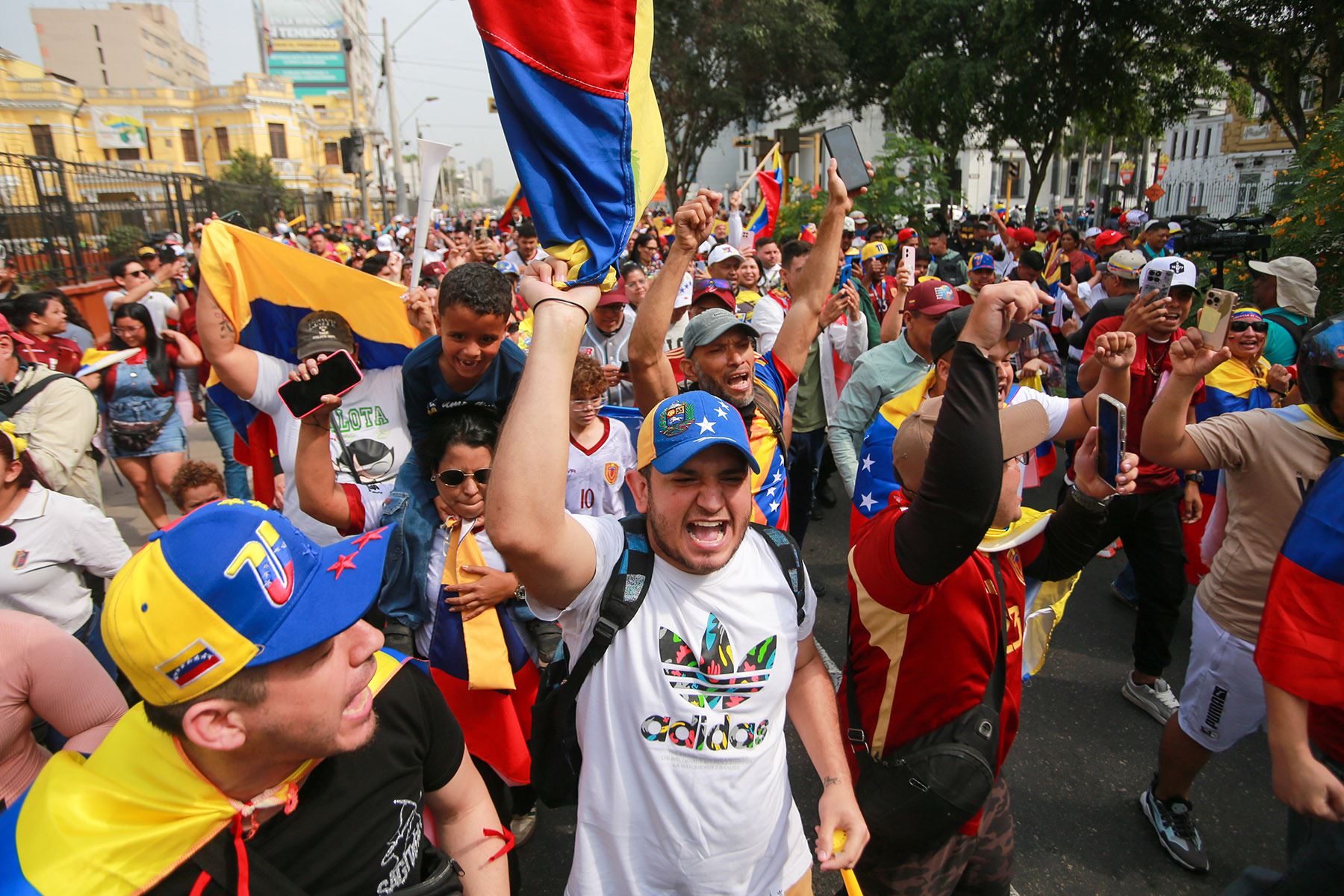
Celebration
“Happy because Maduro has finally fallen. This will go down in history,” said a Venezuelan man as he waved his yellow, blue, and red flag and sang along with other demonstrators, dressed in polo shirts and caps with the national colors.
A woman, her voice trembling and her flag held high, summed up the feelings of many migrants.
“I’ve been waiting years for this moment. I couldn’t be there for my mother’s death. I left because of the circumstances. I’m grateful to Peru for welcoming us, and I dream of returning. Venezuela will be great again and will be a prosperous nation.”
Amid the jubilation, Óscar Pérez, president of the NGO Venezuelan Union in Peru, urged caution. “This is a time for celebration, but it must be marked by restraint, responsibility, and reflection. This is just the beginning of something much bigger,” he said.
“It is important to guarantee the physical safety of our people. There are reports of a state of siege and intimidation to prevent protests. We call on the international community to facilitate a democratic transition,” he stated, while also asking the Venezuelan Armed Forces to “stand on the side of the established institutions.”
According to data from this NGO, approximately 1.7 million Venezuelans currently reside in Peru. For many of them, he added, their eventual return still seems distant.
“The economic, social, and political conditions are not right. This will be a gradual process,” Pérez said.
The testimonies echoed the same sentiment. “It seems like a dream. We have dreamed so many times,” said Raquel, a resident of Peru for nine years, unable to hold back her tears.
“We never thought about leaving our country. What we want is to return and live in peace,” she emphasized.
Another Venezuelan living in Peru, his voice breaking, sent a message to his family. “We are joyful all over the world. Today we celebrate Venezuela’s freedom and the possibility of returning home. My mother is there. We will see each other soon.”
Overflowing with joy, the attendees began a spontaneous march down Arequipa Avenue, singing the national anthem and dancing to Venezuelan music, while waving flags and shouting “Free Venezuela!” on a day marked by the emotion of seeing their homeland free from dictatorship.
More at Andina:
(END) ICI / MDV
Published: 1/3/2026