President Keiko Fujimori announced today that her administration will implement an additional injection of S/ 18 billion (approximately US$ 5.2 billion) for 2027. The initiative aims to protect the most vulnerable families, create jobs, strengthen public infrastructure, and sustain economic growth in the face of the climate-related and external shocks currently confronting the country.
“We are going to approve an additional 18 billion soles (US$ 5.2 billion) for next year. Fiscal rules will be adjusted; we have the financial capacity to do so,” the President stated during the presentation of countercyclical fiscal policy measures at the Government Palace.
Explaining the scope of this decision, the head of state specified that the funds will be allocated as follows: approximately S/ 2.5 billion (US$ 723 million) will go toward cash transfers for the most vulnerable families, to be distributed over a period of three to five months, depending on their specific needs.
In addition, S/ 2 billion (US$ 582.2 million) will be allocated for the maintenance of public works—aimed at rapid job creation—and approximately S/ 500 million (US$ 145.5 million) will be used to subsidize fuel in light of rising prices.
The largest portion of these funds, amounting to S/ 13 billion (US$ 3.785 billion), will be directed toward infrastructure.
Of that amount, S/ 6 billion (US$ 1.747 billion) will fund educational projects, and S/ 7 billion (US$ 2.038 billion) will facilitate the completion of stalled infrastructure projects that are already well advanced.
“Of this 13 billion [soles] (US$ 3.785 billion), 6 billion soles (US$ 1.747 billion) will go toward educational infrastructure. As you know, education is one of the pillars of this administration. It will be one of our great legacies,” the president stated.
In this context, the president addressed a special message to Peruvian families, emphasizing that—beyond the economic figures—the announced measures aim to address the population's needs and provide security in the face of upcoming challenges.
“Behind all these figures and the economic explanations provided by the minister lies something that concerns us all: ensuring the stability of your homes and jobs, as well as the future of your children,” she said.
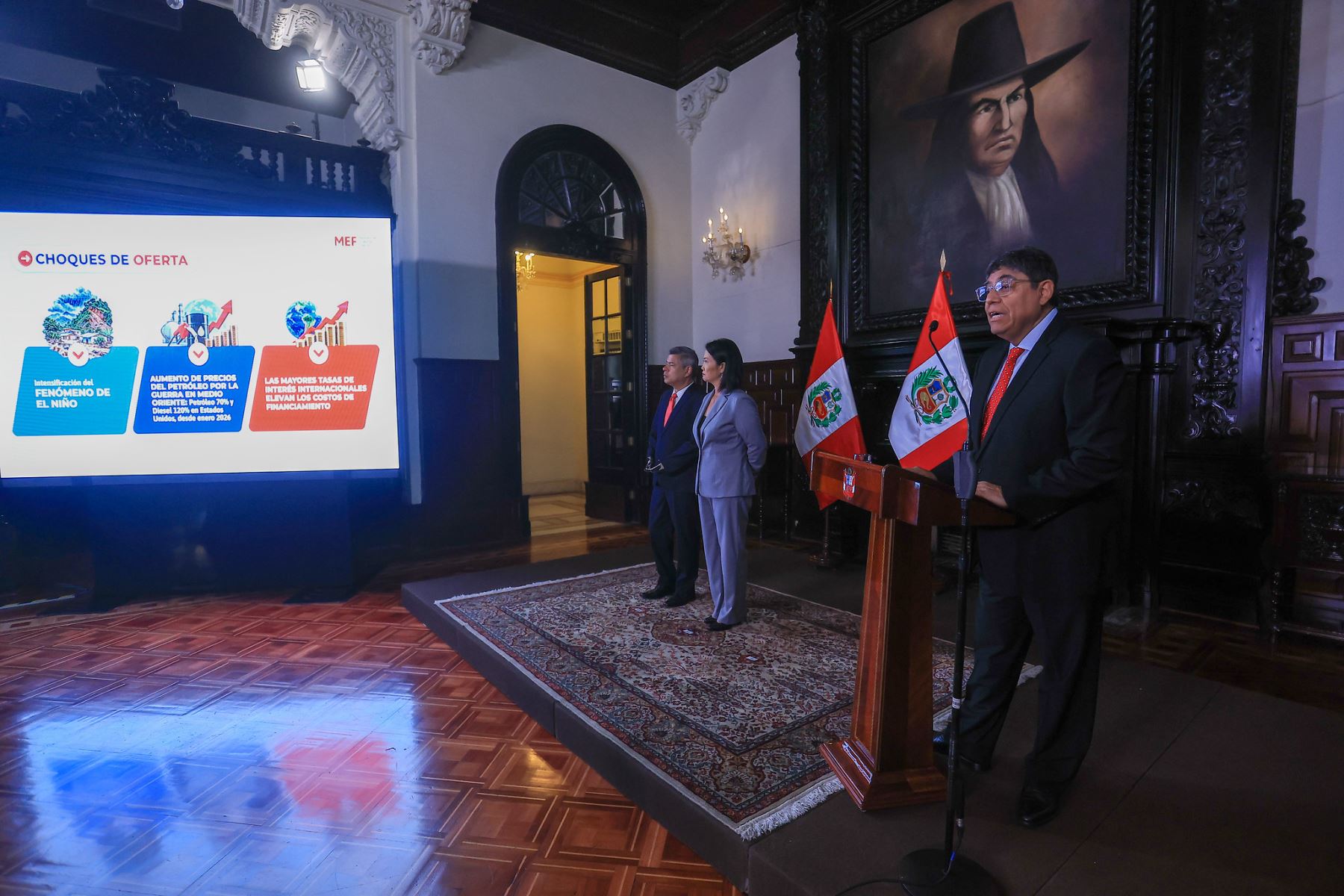
The president further explained that this fiscal package is a response to three shocks threatening the performance of the Peruvian economy.
“As we know, difficult times lie ahead due to three shocks: the El Niño phenomenon; fuel prices, driven by the war in the Middle East; and high interest rates in major economies,” she explained.
Regarding the rainfall associated with this climate phenomenon, she warned that heavy rains along the northern coast and droughts in the south pose risks to homes, roads, schools, and farmland—a situation that necessitates stronger preventive measures and support for vulnerable populations.
Given this scenario, President Fujimori highlighted that the new measures will enhance the State’s response capacity and help address the economic and social consequences of these events.
Furthermore, she expressed her confidence that the country will be able to navigate these difficulties without halting its growth.
“That is why today is a great day. And while it is true that a ‘mega’ El Niño is approaching, the State’s response is even more robust. It is a strong and historic response,” she emphasized.
Government Responses
During her remarks, the President noted that the Executive branch has already begun taking action to address economic and climate-related risks—including a supplementary credit approved in an initial vote by the Congress of the Republic, as well as support measures for the transport sector in light of rising fuel costs.
Regarding preparations for the El Niño phenomenon, she highlighted the progress made along the Piura River.
“The journalists who have been following our work are aware of the progress we have achieved. The Piura River, in the ‘Los Ejidos’ area, now has a capacity of 4,000 cubic meters. At the same time, we are constructing temporary shelters for 30,000 people,” she underscored.
In addition to these efforts, five Peruvian Navy vessels have been made available to assist the populations most in need, and field hospitals have been deployed to the regions of Tumbes, Piura, and Lambayeque.
Furthermore, the President mentioned the installation of bridges in the northern region and the availability of over 5,000 tons of food supplies to meet the population’s needs in the event of potential emergencies.
Fiscal Responsibility
The head of state explained that the package of measures was analyzed, debated, and agreed upon within the Council of Ministers, as part of a joint assessment of economic conditions and the resources available to address the country’s priorities.
“The minister has also spoken with the head of SUNAT [the national tax authority]. We are all in full agreement that Peru possesses solid macroeconomic figures, which allow us to implement these additional measures,” she stated.
She noted that the decision to modify fiscal rules includes raising the deficit to 2.4% of GDP by 2027, leveraging the strength of public accounts to navigate an exceptional set of circumstances.
In this regard, she acknowledged the contributions of economy ministers from previous administrations to Peru’s economic stability and their responsible management of public resources over the last few decades.
“I also pay tribute to all the economy ministers our country has had since the adoption of the 1993 Constitution; they took responsible actions to safeguard Peru’s finances, which now places us in a strong position to confront this significant economic slowdown,” she highlighted.
Furthermore, she reaffirmed her confidence in the country’s ability to overcome these challenges, noting that the primary objective is to achieve higher economic growth in 2027 than in the current year, despite the impact of external shocks.
“The challenge—as the Minister of Economy has stated—is to ensure that, despite the difficulties, we achieve greater growth next year than we have this year,” she indicated.
Along these lines, she reiterated that the announced measures will help sustain economic activity and address the needs of families in the face of rising costs and climate-related threats.
“We are firmly convinced that neither the El Niño phenomenon nor the rise in fuel prices will, in any way, halt our country’s growth,” she emphasized.
During the presentation of these measures at the Government Palace, the President was accompanied by the President of the Council of Ministers, Luis Galarreta, and the Minister of Economy and Finance, Elmer Cuba.
Measures to be implemented
Previously, the Minister of Economy and Finance, Elmer Cuba, presented the key measures the government will implement as part of its countercyclical fiscal policy, aimed at protecting vulnerable populations, addressing infrastructure needs, and supporting affected economic activities.
First, he explained that the plan includes providing financial grants (bonuses) to vulnerable families in the southern Andean region, households in the north affected by heavy rains, and individuals impacted by mudslides and river overflows. This support will also extend to other vulnerable groups, including retirees and the elderly.
As a second measure, the Minister detailed that maintenance work will be carried out on schools, health centers, police stations, and roads, with the goal of meeting infrastructure needs and ensuring the continued provision of public services across various regions.
Regarding investment, Minister Cuba noted that priority will be given to approximately 250 public works projects that are more than 50% complete, in order to accelerate their finalization and make them available for public use.
The strategy also accounts for remaining balances from "works-for-taxes" projects and affordable housing programs, such as Mivivienda and Techo Propio.
Finally, the Minister explained that mechanisms to inject liquidity will be implemented to support economic activities affected by the current situation.
These include the deferral of tax obligations, the release of funds held in tax-withholding accounts, and the provision of guaranteed loans for micro and small enterprises (MSEs) through the Fondo Crecer.
More from Andina:
(END) NDP/FHG/CCR / MDV
Published: 10/22/2026