Culture Minister Alfredo Luna announced that a report will be available by September to determine the appropriate visitor capacity for the
Historic Sanctuary of Machu Picchu.
In remarks to TVPeru, the Executive Branch representative said the contract for conducting the corresponding study will be awarded in the coming weeks.
The preparation of the study is expected to take approximately five to six months.
"By September, we should already have it," he pointed out.
The high-ranking official recalled that the visitor capacity for Machu Picchu was set in 2019 and has not been modified so as not to halt any activity.
Document content
Minister Luna explained that the report to be prepared must establish parameters regarding the number of visitors, the conditions under which they should move around Machu Picchu, the available access points, and the visitor circuits to be followed.
There are currently three such circuits, but "the idea is to have more."
The Cabinet member said the circuits must be adapted to the type of tourism being practiced.
He noted that while some visitors to Machu Picchu seek to explore the archaeological site, others are more interested in the biodiversity found there.
"Each one requires a specific approach in terms of how the visit is oriented," he indicated.
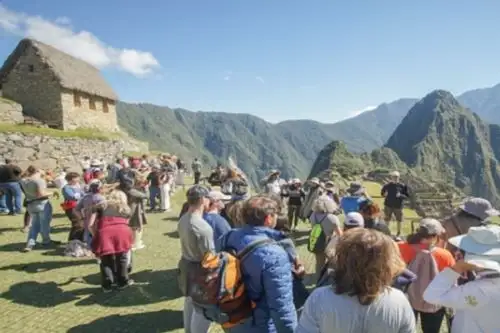
Luna stated that Machu Picchu received 1.6 million visitors in 2025. He noted that daily arrivals reach 5,600 tourists during the high season.
In the low season—which is typically favored by Peruvian visitors—the number has fallen from 4,500 to 3,000, as domestic tourists tend not to plan their visits in advance.
New Master Plan
The minister recalled that on January 8—marking the 45th anniversary of the creation of the Historic Sanctuary of Machu Picchu—the site's Master Plan, with a horizon set for 2046, was approved.
The government official added the plan will be implemented between 2026 and 2030.
He underscored that the Historic Sanctuary of Machu Picchu is home to 60 archaeological monuments, 80 mammal species, more than 400 bird species, and over 3,000 botanical species within the Natural Park.
In this sense, the Cabinet member indicated "the Master Plan will allow us to follow a set of guidelines to address climate change," as well as forest fires resulting from both climate-related factors and human activity.
Regarding the archaeological park, Luna said it requires constant management to address the effects of rainfall and contact with tourists.
He also stressed the need to preserve the stones used in the construction of Inca structures, which are exposed to fungi and rainfall that cause their deterioration.
Lastly, Minister Luna noted that around 20% of the citadel was reconstructed by archaeologists over time.
He added these sections do not have the structural strength of the original construction and therefore require reinforcement.
(END) FGM/MVB
Published: 1/12/2026