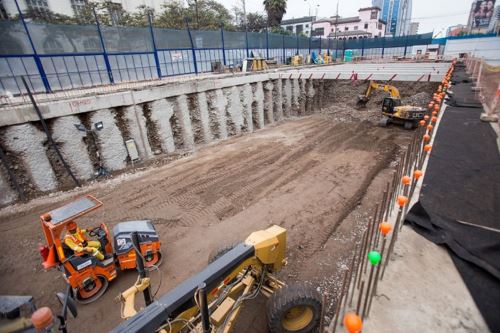
The multiplier effect of the construction sector on the economy is more than evident. National Society of Construction and Infrastructure (SNCI) Executive Director Cesar Candela said
confirms that the sector has positioned itself as one of the recovery's main drivers, with expansion close to 9%—a pace rarely seen in other key industries.
"For March, the most plausible scenario is still a high rate, in the range of 6% to 8%; that is, well above overall gross domestic product (GDP) growth," he said, according to the Economika supplement of Official Gazette El Peruano.
The executive noted that this performance would stem from a combination of higher domestic cement consumption, linked to private projects, housing, and self-construction.
It would also be supported by faster execution of road and sanitation infrastructure works at the subnational level, as well as the momentum of already committed real estate plans.
He stressed that sustaining this pace will depend on continued public investment and the absence of disruptions in the construction materials supply chain.
Significant contribution
The executive director emphasized that, in an economy such as Peru's, construction plays a structural role due to its high multiplier effect and its ability to link productive chains.
"It not only represents a significant share of GDP, but directly impacts industrial activities (cement, steel, and materials), business services, transport, logistics, and finance," Candela indicated.
"At the same time, it is a labor-intensive segment, with a strong impact on direct and indirect employment, particularly in regions where formal job opportunities are more limited," he pointed out.
The SNCI representative underlined that construction serves as a vehicle to close infrastructure gaps: roads, bridges, water-sanitation systems, hospitals, schools, and formal housing.
This means its dynamism not only boosts short-term growth, but enhances total factor productivity and the country's competitiveness in the medium term.
In short, when this activity expands, GDP rises, productive capacity increases, jobs are created, and social gaps narrow, Candela stated.
According to SNCI projections, the sector is expected to grow above overall GDP in 2026 and consolidate its role as one of the main contributors to annual expansion.
"Unlike 2025, when the sector was still in a more gradual recovery phase, early 2026 shows significantly higher rates, pointing to a stronger contribution to output," he underscored.
Regions
Candela noted that regional performance in construction is heterogeneous, although clear pockets of dynamism can be identified, linked to major projects and integration with key productive activities.
"In the north, progress is largely driven by road works, irrigation projects, and urban expansion tied to agro-exports, which generates demand for infrastructure and housing," he said.
In the central area—including Lima's influence zone—growth is associated with transport, energy, urban infrastructure, and equipment projects, amid increasing densification.
In the south, the boost comes from mining and gas investment portfolios, logistics and tourism infrastructure works, as well as the consolidation of intermediate cities that demand higher-quality urban services.
Across all these cases, the common factor is the combination of public capital in basic infrastructure and private investment in housing, commerce, and services, within a context of gradually improving connectivity and access to financing.