A new attraction joins the Historic Center of Lima's tourist circuit starting today.
These are the archaeological remains of the former Church and Hospital of the Espiritu Santo (Holy Spirit), discovered beneath the current Santa Rosa de Lima Sanctuary, offering insight into part of the site's history before the construction of the temple that now welcomes thousands of visitors.
The Metropolitan Municipality of Lima, through the Lima Historic Center Planning, Management, and Restoration Office (Prolima), on Tuesday presented the archaeological findings uncovered during research and enhancement works carried out in a section of the sanctuary.
What was found beneath the stones and debris?
The archaeological remains were hidden beneath stones and debris.
Among the main discoveries is part of the former Hospital of the Holy Spirit, an institution founded by Greek merchant Miguel de Acosta that began operating on May 23, 1575, with authorization from Viceroy Francisco de Toledo.
The hospital was initially established to treat sailors, pilots, and other workers involved in these activities.
Over the years, however, it built a solid reputation and came to provide care to various sectors of viceregal society.
It remained in operation until the early years of the Republic, when it was relocated to Bellavista Hospital in Callao.
The archaeological research made it possible to identify the entrance to the former Church of the Holy Spirit, consisting of two side walls built of stone, brick, and adobe, and joined with lime mortar.
Inside, beneath a floor made of flat bricks, various burial contexts were found, both within rectangular niche-like structures and directly in the ground.
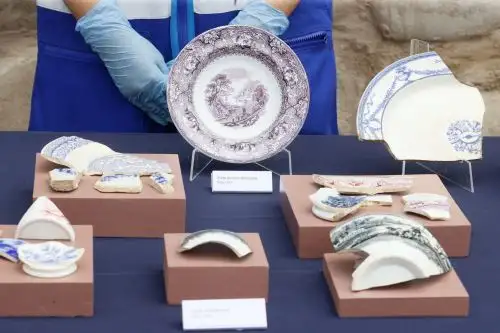
Among the recovered materials are also 18th-century Valencian tiles, measuring 21 by 21 centimeters and decorated with plant motifs, which provide insight into the characteristics and uses of this former space.
Six-petaled flower
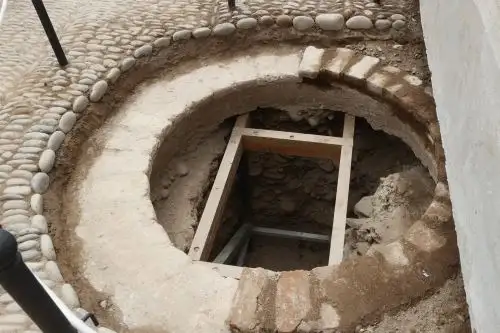
Another of the most remarkable discoveries is located in the area that once served as the hospital's entrance.
There, archaeologists uncovered a large cobblestone floor featuring the design of a six-petaled flower within a circle.
The tips of the petals were made from animal bones, a detail that makes this feature one of the most striking discoveries of the intervention.
The former Church and Hospital of the Holy Spirit not only served religious and charitable functions.
During the Viceroyalty, the building hosted academic activities, including courses in mathematics, navigation, and cosmography as well.
In the Republican era, its premises were used by institutions such as the Madama Nussard Holy Spirit School for Young Women, the National Museum, and later the National School of Engineers.
Conservation of archaeological remains
Prolima's work includes measures to preserve the archaeological remains that were found.
Conservation processes are being applied to the cobblestone floor and other archaeological elements to preserve their original design, construction techniques, and materials.
Similarly, work is underway to consolidate mural painting remains and preserve the brick and adobe walls that formed part of the former building.
The intervention aims to eventually integrate these findings into the area of the Santa Rosa de Lima Sanctuary where they were discovered, allowing visitors to appreciate them and helping shed light on the history of the capital's Historic Center.
Residents invited to explore Lima
The presentation was held at Santa Rosa de Lima Sanctuary, located in the first block of Tacna Avenue in Lima's Historic Center.
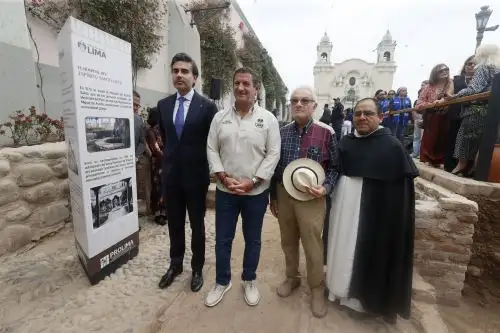
The event was attended by Lima Mayor Renzo Reggiardo, who highlighted that the enhancement of these archaeological remains is taking place during the month dedicated to Santa Rosa de Lima.
"We are talking about a discovery that is nearly 500 years old. It is one of the hospitals dating back to the Viceroyalty. We hope the public will come and explore the city's tourist circuit. We are carrying out a series of activities to restore the city's infrastructure and in other areas, such as gastronomy," he said.
Reggiardo also highlighted the work carried out by Prolima to restore elements that are part of Lima's history and identity.
Prolima: Discovery contributes to Lima's identity
Prolima Manager Luis Martin Bogdanovich invited the public to visit and help preserve this new space, which has been added to the capital's tourist attractions.
"It joins Lima's tourist attractions and contributes to the city's memory and identity," he indicated.
The Prolima official said that Prolima has been working in various areas of the Historic Center with the aim of restoring the city.
Bogdanovich added that this discovery will be incorporated into the tourist circuit, which can be visited starting today.
"People who visit the sanctuary to leave a letter will be able to take a look here and learn a little more," he concluded.
(END) NDP/RRC/MVB
Published: 8/25/2026