00:30 | Barranca (Lima region), May. 10.
A group of stone-and-adobe platforms, walls, ceremonial plazas, and abundant archaeological material found at the Cerro de la Horca Archaeological Site reinforces the hypothesis that this complex may have been one of the main religious and political centers in the lower Fortaleza Valley between A.D. 900 and 1400, in what is now Barranca province, Lima region.
This was stated by archaeologist Jose Luis Fuentes, director of the research project currently underway at this important settlement located about four kilometers north of Paramonga, near kilometer 513 of the Pan-American Highway.
Speaking with Andina News Agency, Fuentes explained that Cerro de la Horca is one of the largest and most complex sites in the lower Fortaleza Valley due to the large number of architectural structures it contains.
"There are around 20 mounds surrounding four plazas, in addition to platforms, walls, and internal roads. It is a highly complex site with no equivalent in that specific part of the valley," he noted.
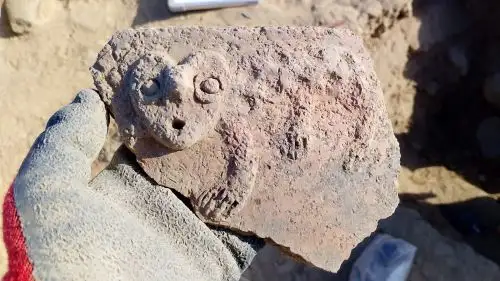
Possible sanctuary of a local deity
The archaeologist from National University of San Marcos said one of the most relevant aspects of this research is the hypothesis that Cerro de la Horca may have functioned as a sanctuary dedicated to a regional deity linked to ancient religious traditions of Peru's central coast.
Fuentes explained that at the main hill's top — about 90 meters high — there are three platforms facing a cliff overlooking the Fortaleza River's mouth.
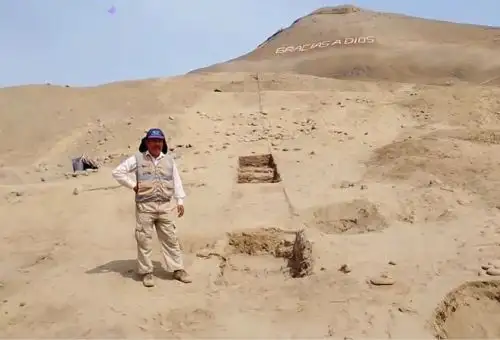
Since the 19th century, travelers and researchers have collected accounts of alleged executions carried out by the Chimú and Incas, who were said to have thrown people from that precipice.
"It appears that the name Cerro de la Horca comes precisely from those legends," he remarked.
The archaeologist also recalled that in the 1930s, French researcher Louis Langlois found in the area an idol made of algarrobo wood measuring approximately 1.20 meters in height, depicting a figure with iconography associated with the Pativilca culture.
The discovery would reinforce the idea that the site housed an important regional deity, possibly linked to the cult of Pachacamac.
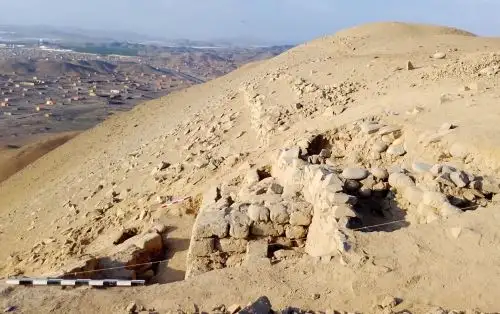
Architecture from different periods
Speaking with Andina News Agency, the researcher said excavations carried out over the past two months made it possible to identify at least two major construction phases at the top of the site: an older stage built with stone and a later one made of adobe.
"We are partially confirming what traveler Charles Wiener mentioned in the 19th century, when he spoke of three construction phases at this site," he indicated.
The stone phase would be associated with the Pativilca culture and would correspond to the Late Middle Horizon; meanwhile, the adobe remodeling would be linked to Inca occupations during the Late Horizon.
In other sectors of the complex, walls built with rounded stones bonded with mortar were found, along with adobe structures characteristic of local societies.
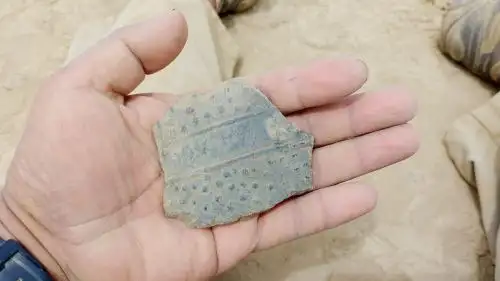
Ceramics and remains from various cultures
Among the main discoveries are ceramic fragments, textiles, as well as organic and botanical remains belonging to various cultural traditions.
According to Jose Luis Fuentes, preliminary evidence shows the presence of materials linked to the Pativilca, Casma, and Huaura cultures.
Fragments decorated with iconography characteristic of these societies were also found.
The archaeologist explained that the site may have been continuously occupied from around A.D. 900 until the Inca expansion.
During that period, the Fortaleza Valley may have come under the control or influence of different regional groups, including the Casma culture and later the Chimu.
"The Casma culture developed approximately between A.D. 1100 and 1300 and appears to have occupied the Fortaleza Valley as well before the Chimu expansion," he stressed.
Residences linked to religious worship
The research also suggests that the large mounds in Sector B may have served as residences or ceremonial spaces associated with the main sanctuary located at the top of the hill.
"Priests or elite groups in charge of the deity's worship may have lived below," Fuentes said.
Ceremonial plazas, terraces, walled enclosures, and terraced structures up to 10 meters high built with rounded stones were identified in the area.
Likewise, some areas may have been occupied by lower-ranking populations due to the presence of dwellings made of cane and possible storage facilities for food and goods.
Scientific and tourism potential
The specialist highlighted that Cerro de la Horca has enormous potential for future archaeological research, as well as for tourism development in the province.
"With a larger-scale project and better funding, it could become a major attraction for Paramonga," he stated.
The current excavation project has authorization from the Ministry of Culture and will conclude this week.
However, Fuentes acknowledged that the initiative is being carried out mainly with personal resources and occasional support from some families and the local municipality.
Despite the financial limitations, the archaeologist believes that the findings obtained so far represent only the beginning of investigations that could reveal new details about the ancient societies that inhabited the Fortaleza Valley and its religious importance on Peru's pre-Hispanic coast.
(END) MAO/MVB
Published: 5/10/2026