16:18 | Cusco (Cusco region), Mar. 16.
The city of Cusco on Sunday, March 15, concluded the Cusco Carnival celebrations at the Plaza Mayor with great joy, identity, and pride, drawing local families along with domestic and international tourists.
Delegations from rural communities, where these celebrations remain deeply rooted, arrived yesterday accompanied by residents from districts and the 13 provinces.
They gathered to reaffirm the value of this traditional and customary festival under the name "Qhaswa Raymi."
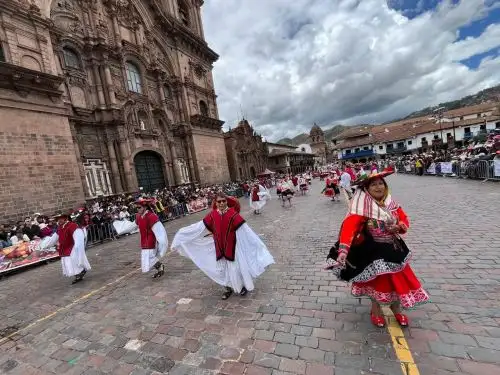
Although the closing celebration was scheduled to begin very early, the nearly 100 delegations had yet to finish parading through the Main Square’s perimeter after entering via El Sol Avenue.
They displayed joy and identity, as has occurred in recent years since "Qhaswa" was designated as a more reivindicatory "Raymi."
This festival was opened by carnival delegations from Arequipa, Apurimac, and Ayacucho, who
delighted attendees with their songs and music performed to the rhythm of guitars, small drums, and quenas.
In these regions, carnivals are a longstanding institution and consistently attract the attention of domestic and international tourism.
Afterward, the Main Square—known in Quechua as Hawqaypata—filled with color, traditional music, dance, carnival groups, and the joy of their performers.
Each delegation brought floats featuring symbols or artistic expressions from their localities, as well as displays of agricultural production or other living traditions they proudly represent.
Meanwhile, foam, water balloons, and colored powder were thrown as part of the celebration.
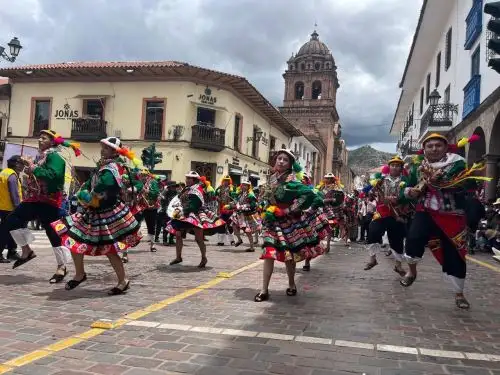
Music amplified through microphones and loudspeakers featured guitars, charangos, bandurrias, quenas, drums, as well as the high-pitched singing of women and even older adults who did not miss this lively celebration.
During the festivities, brief rain showers fell, but they did not matter and instead further fueled the desire to keep celebrating.
"Qhaswa Raymi" aims to become institutionalized in the Tahuantinsuyo’s capital, as rural traditions are meant to be shared with new generations of Cusco residents, in addition to visitors who enjoyed, celebrated, and experienced the living culture of this region.
Many of these dances form part of the celebrations marking Cusco’s jubilee month, showing that Cusco is always in a festive mood.
"Carnival is celebrated as a tribute to agricultural production. In the communities, it has been held for decades in the 'champion of champions,' but they did not have the opportunity to come here to our capital, and today we have recovered it while hoping to institutionalize it," Cusco Governor Werner Salcedo Alvarez told Andina News Agency.
"Cusco should not be known only for Machu Picchu, Sacsayhuaman, and our archaeological sites; Cusco must be known for its living culture — not only for Inti Raymi, but for Qhaswa Raymi and Qhapaq Raymi as well, activities that had remained hidden and must be revalued at the level of Cusco, powerful enough to invite tourism," he added, noting that the region increasingly offers intangible culture comparable to that of Cajamarca, Ayacucho, and Apurimac.
While people enjoyed a pleasant day at San Francisco Square, they sampled the traditional carnival dish known as Puchero, or Cusco T'impu.
It was prepared with lamb, cassava, potatoes, chickpeas, carrots, peaches, cabbage, rice, and a flavorful broth made from lamb stock, accompanied by Chicha de Jora (a traditional fermented corn drink) and frutillada (a strawberry-based fermented corn drink).
Winners
This competition used to be held at Tupac Amaru Square in Wanchaq district; however, due to its growing significance and the increasing number of Cusco residents and visitors—who this year were seated in installed grandstands—authorities decided to move it to Cusco's largest square.
At the end of this celebration, the winners were announced: the representative dances of Huancarani (first place), Yanaoca (second place), and Kimbiri (third place) in the indigenous dances category.
In the indigenous peoples category, the top places were awarded to Tinta (first place), Taray (second place), and Quiquijana (third place).
As for the regional offices category with floats, the top places were awarded to the Regional Education Management Office and Plan Meriss.
Regarding the gastronomic festival, the top places went to La Convencion and Canchis provinces.
In the allegorical parade category, La Convencion and Canchis provinces took the top places. Meanwhile, at the district level, the Municipalities of San Pablo and Marangani ranked among the winners.
(END) PHS/MAO/MVB
Published: 3/16/2026