By Luis Zuta DávilaIn his final homily in Peru—delivered during a Mass held at the Las Palmas airbase—Pope Leo XIV once again spoke of the significant work carried out in Peru by Saint Toribio de Mogrovejo, as well as the saint’s influence on him and on the Church’s efforts to defend the Indigenous population and the most vulnerable.
This connection was particularly evident on Saturday, November 14, when Leo XIV visited the sanctuary dedicated to the saint in Zaña, Lambayeque.
There, he shared a previously little-known detail: before beginning his own episcopal ministry in Chiclayo, he spent the night in prayer, seeking the intercession of Saint Toribio so that he might become a good shepherd.
This revelation helps explain why the American-born pontiff—who also holds Peruvian citizenship—considers the former archbishop a fundamental point of reference in his own religious journey.
But who is Saint Toribio de Mogrovejo? What work did this cleric perform, and what was the nature of his special relationship with our country? What is celebrated in November, and why is it significant?
Biography of Toribio de Mogrovejo
Toribio Alfonso de Mogrovejo y Robledo was born on November 16, 1538, in the Spanish town of Mayorga, which was then part of the Kingdom of Castile. He was born into the Castilian nobility; his father was Don Luis Alfonso de Mogrovejo, lord of the House of Mogrovejo in Mayorga, and his mother was Doña Ana de Robledo y Morán de Butrón, who belonged to the noble House of Morán de Butrón of Villaquejida-Mayorga and Logroño.
Toribio de Mogrovejo studied civil and ecclesiastical law at the University of Salamanca. There, he came under the influence of his uncle, Juan de Mogrovejo, a professor at that institution as well as at the Colegio Mayor de San Salvador de Oviedo in Salamanca. Invited by King John III of Portugal to teach in the city of Coimbra, Juan de Mogrovejo traveled with his nephew, Toribio, and both resided for several years at the university in that city.
Upon their return to Salamanca, his uncle passed away shortly thereafter. Toribio decided to follow in his footsteps, becoming a professor of law at the University of Salamanca, where his erudition and virtue led to his appointment as Inquisitor General of Granada.
Appointment as archbishop and arrival in Peru
King Philip II, who was reigning at the time, proposed to Pope Gregory XIII that Toribio de Mogrovejo be appointed Archbishop of Lima, succeeding Gerónimo de Loayza. On May 16, 1579, Pope Gregory XIII named him the second Archbishop of Lima, pursuant to a royal nomination decree.
The archbishop who was to ordain him as a priest offered to confer all the minor orders upon him in a single day; however, Toribio de Mogrovejo preferred to receive one order each week, allowing him to properly prepare himself for each one.
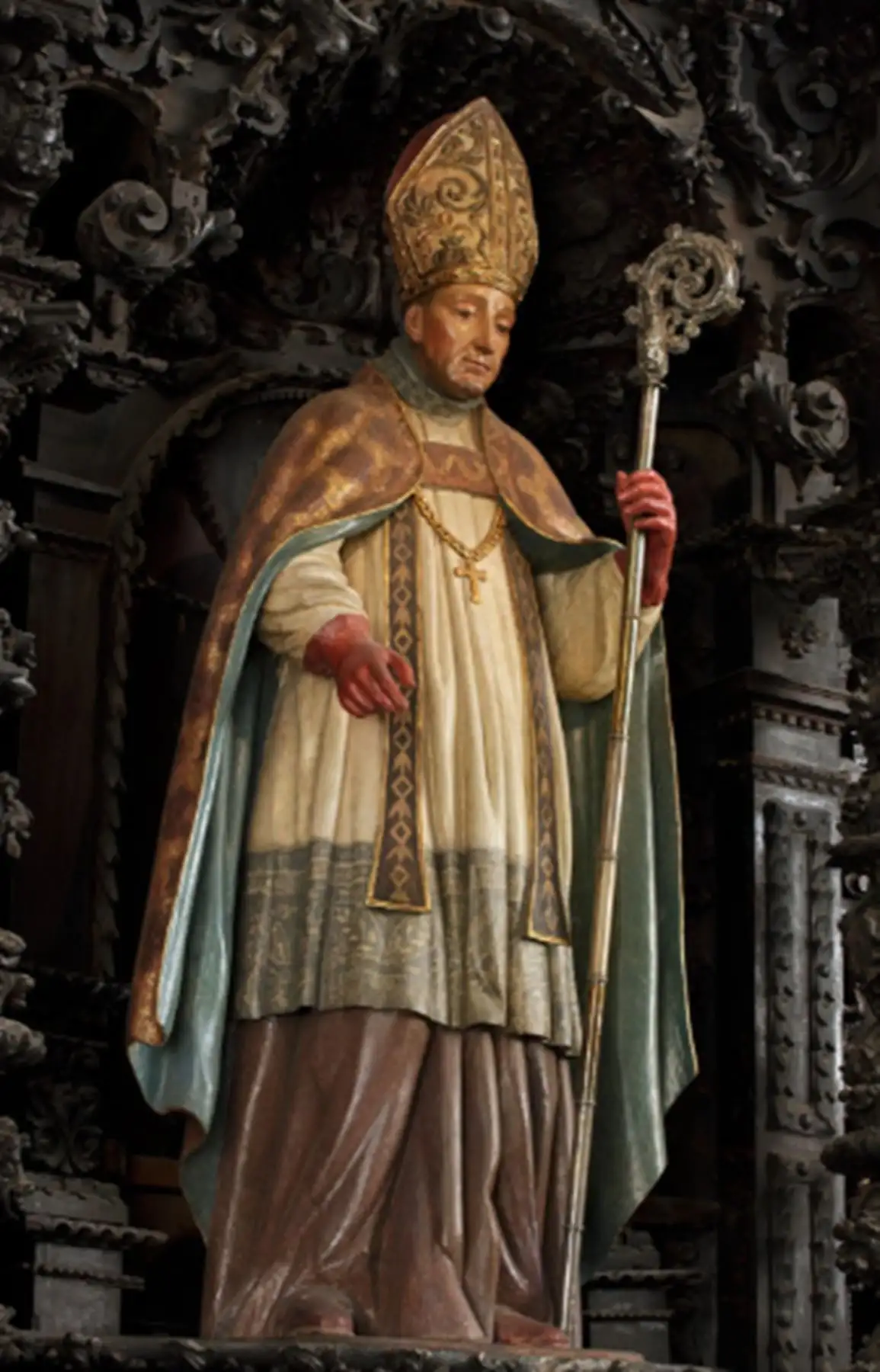
Toribio de Mogrovejo was ordained a priest in 1578 by the then-Archbishop of Granada, Juan Méndez de Salvatierra. He was consecrated in August 1580 at the Cathedral of Seville by the Archbishop of Seville, Cristóbal Rojas Sandoval.
He departed for Peru accompanied by his sister, Grimanesa de Mogrovejo. ...his brother-in-law, Francisco Quiñones, and his three nephews in September 1580. He arrived in Panama and, traveling by land and sea, reached the port of Paita in the Viceroyalty of Peru in May 1581. He began his missionary work, traveling on foot and by mule, baptizing and instructing the native population. He arrived in Lima on May 11, 1581, and took canonical possession of his see on May 12, 1581.
The Archdiocese of Lima held jurisdiction over the present-day territories of Peru, Ecuador, Colombia, Venezuela, Bolivia, Chile, and part of Argentina, encompassing an area of more than six million square kilometers.
Evangelizing work
Upon his arrival in Lima, Toribio de Mogrovejo was 42 years old; he would go on to traverse his vast Archdiocese three times. The first journey, which began in 1584 and lasted seven years, took him to Cajamarca, Chachapoyas, and Moyobamba.
The second visitation, carried out between 1593 and 1597, covered the coastal region of the department of Áncash, as well as Trujillo and Lambayeque. The third visitation, which began in January 1605, remained unfinished due to his death. Between these major journeys, he also visited towns such as Lima, Callao, Mala, San Vicente de Cañete, Chincha, and Nasca.
Most of these journeys were made on foot—or occasionally on muleback—along nearly impassable paths, crossing through environments that ranged from bitterly cold climates to regions of stifling heat.
Upon arriving in each locality, he would gather the local population—primarily Indigenous people, as well as those of African descent where applicable—and remain for several days to evangelize, baptize, and confirm adults, minors, and the elderly. He also blessed the sick and administered the sacrament of extreme unction (anointing of the sick) to those near death, offering them spiritual strength, peace, and the forgiveness of their sins.
He celebrated Mass with great fervor; according to many of the faithful, his face would shine while he prayed—a phenomenon interpreted as a supernatural, divine occurrence.
During one of his evangelizing visits, a notably warlike tribe approached him with hostile intent; however, upon seeing the archbishop’s profound humility and kindness, they changed their attitude and listened to his message of the Christian faith with great respect and attentiveness.
At the conclusion of his ecclesiastical tenure, Toribio de Mogrovejo sent a report to the King, stating that he had administered the sacraments of baptism, first communion, and confirmation to more than 800,000 people during his pastoral visits throughout the Archdiocese of Lima.
Organization of the archdiocese
Toribio de Mogrovejo convened priests and bishops in synods—general assemblies—to establish guidelines for the conduct of Catholics. Every two years, he would gather the entire clergy of the archdiocese for a synod, and every seven years, he would include clergy from neighboring dioceses. These meetings established strict regulations; unlike other instances where laws were enacted but subsequently ignored, the synods led by Toribio de Mogrovejo included an assessment of adherence to ecclesiastical norms.
Toribio de Mogrovejo founded the first priestly seminary in the Americas. He also insisted—and succeeded—in having religious orders take charge of parishes in impoverished areas. During his tenure, the number of parishes or evangelization centers in the archdiocese increased from 150 to 250.
Confirmation of three saints
In the course of his pastoral work, Toribio administered the sacrament of confirmation to three notable Christians who later became saints: Saint Rose of Lima, Saint Francis Solano, and Saint Martin de Porres.
Death of Toribio de Mogrovejo
At the age of 68, Toribio de Mogrovejo fell ill while in the town of Pacasmayo. Despite his failing health, he continued his pastoral duties until he reached the city of Zaña, where he lay dying.
There, he drew up his will, bequeathing his personal belongings to his servants and the rest of his property to the poor. He passed away at 3:30 p.m. on March 23, 1606—Holy Thursday—at the Convent of Saint Augustine. A year after his death, his body was transported to the "City of Kings" (Lima); despite the time that had elapsed, it showed no signs of decomposition, appearing as if he had only just died.
Canonization and miracles attributed to Toribio de Mogrovejo
Following his death, the canonization process for Toribio de Mogrovejo began immediately, with the Vatican recognizing his heroic virtues.
Toribio de Mogrovejo was beatified on June 28, 1679, by Pope Innocent XI through the papal bull Laudeamus, and was canonized on December 10, 1726, by Pope Benedict XIII through the papal bull Quoniam Spiritus. Among the miracles and wondrous deeds attributed to the intercession of Toribio de Mogrovejo, the following stand out:
The Miracle of Macate: During one of his extensive pastoral journeys through the Viceroyalty of Peru in 1594, Toribio de Mogrovejo and his companions found themselves suffering from thirst in an arid region.
Reminiscent of a biblical account, the saint struck a rock with his staff, causing crystal-clear water to gush forth; this water quenched the travelers' thirst and continues to flow to this day.
The healing of Mateo de Rojas: This is one of the miracles documented for his canonization process. The seminarian Mateo de Rojas, who was gravely ill and suffering from hemorrhaging, was completely cured after touching a rib belonging to the Archbishop of Lima.
The gift of ubiquity: Oral tradition and accounts from the colonial era suggest that Toribio de Mogrovejo possessed the ability to appear in multiple places simultaneously, whether to assist the sick or to carry out evangelization.
Incorruptibility of the body: One year after his death in 1606, his body was transported to Lima and found to be incorrupt—preserved as if he had passed away only recently.
Solemnity in honor of Saint Toribio de Mogrovejo
His feast day in the Catholic calendar is celebrated on March 23, the anniversary of his death. However, in the city of Lima, the Solemnity of Saint Toribio de Mogrovejo is observed on April 27—the day his mortal remains were transferred from Zaña to Lima, where they are now venerated in a chapel within the Basilica Cathedral. On this same day, celebrations in his honor also take place in Mayorga, his birthplace in Spain.
Saint Toribio de Mogrovejo is the patron of the Latin American Episcopate—a title bestowed by Pope John Paul II in 1983—as well as the patron of the Archdiocese of Lima, the town of Mayorga, the Santo Toribio de Mogrovejo Catholic University, the Brotherhood of Saint Turibius of Mogrovejo in the Rímac district, the Missionary Pastoral Ministry of the Santa Cruz Parish (part of the Archdiocese of Resistencia in the Argentine province of Chaco), and the Archdiocese of Managua in Nicaragua.
More from Andina:
(END) LZD / MAO / MDV
Published: 11/16/2026