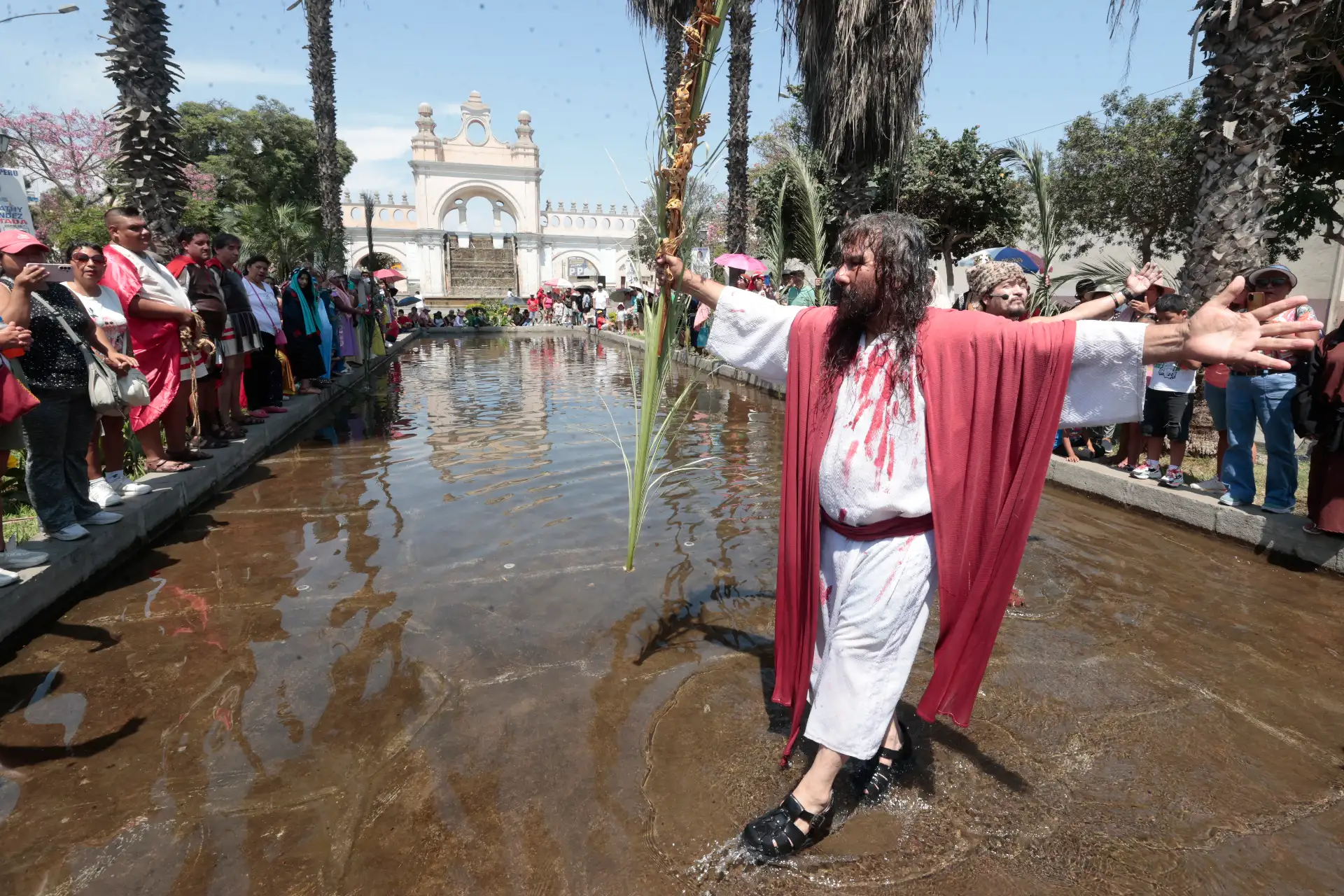
Actor Mario Valencia —artistically known as "Cristo Cholo"— together with his theater group, staged a symbolic reenactment of Jesus Christ's baptism in the fountain at Paseo de las Aguas in Lima's Rimac district during Holy Thursday in 2026.
Dressed in his traditional white and red tunic and carrying a two-meter palm staff, the well-known Lima-based performer recreated the moment when John the Baptist immerses Jesus in the Jordan River.
The staging took place before dozens of faithful, local residents, and tourists who gathered along Madera Street.
The reenactment was broadcast live by the Municipality of Lima.
More than 100 actors from the Emmanuel Theater Group participated in the performance, which included chants, the washing of the feet, and a reflective message from Valencia on the forgiveness of sins and the spirit of Holy Week — a tradition that has spanned decades in Rimac district.
"Cristo Cholo"—who has portrayed Jesus for nearly 50 consecutive years—knelt to receive the baptism as water was poured over his head, proclaiming in the name of the Father, the Son, and the Holy Spirit, moving those in attendance with this devout recreation.
The activity is part of the Holy Week 2026 program, which began on Palm Sunday with a procession through the Historic Center. It will continue on Good Friday with the Via Crucis to San Cristobal Hill, drawing thousands of Lima residents in an expression of faith and tradition.
For the first time, women will carry the cross alongside "Cristo Cholo" this year.
Holy Thursday: Seven-church visit tradition
Another hallmark activity of Holy Thursday is the visit by the faithful to seven churches, a deeply rooted practice not only in Peru but in various parts of the world that follow the Catholic faith.
What is the origin and meaning behind this longstanding tradition? Here is what we know.
According to historical and religious sources, this rite began in Rome in 1552 with Saint Philip Neri, founder of the Congregation of the Oratory.
He proposed visiting seven major Roman churches: St. Peter's, Saint Mary Major, Saint Paul Outside the Walls, Saint John Lateran, Saint Lawrence, Holy Cross, and Saint Sebastian.
It was a public procession that combined songs and sermons.
Bishops, cardinals, and other church prelates joined this pilgrimage, whose main purpose was to symbolically recall and accompany Jesus along the path he followed from the night of his capture to his crucifixion.
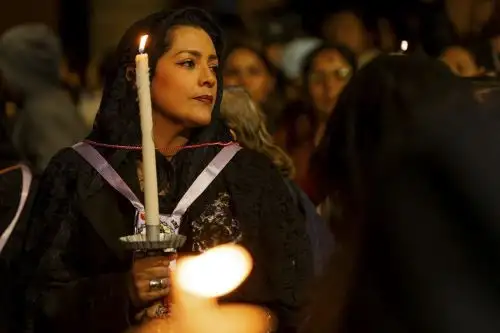
The seven-church visit typically begins after the Holy Thursday Mass, when only the Blessed Sacrament of the Eucharist remains exposed for the faithful to visit.
In addition, all images inside the church are covered with a purple cloth as a sign of penance and mourning, and above all to avoid distractions, as the sole focus during these liturgical days should be on the passion and death of Jesus Christ.
Why seven churches?
The explanation lies in the symbolic nature of the number, which appears frequently in the Bible and in the Catholic Church.
For example, God created the world in seven days; there are seven sacraments; Jesus told Peter to forgive his brother seventy times seven; and Jesus spoke seven words from the cross.